

A restaurant tax accountant can be the difference between a restaurant that survives and one that thrives. Rising food costs, higher employer National Insurance, VAT at 20% on almost everything you sell and a corporation tax rate of up to 25% mean that many UK restaurant owners are paying far more tax than they need to. At NS Accounting, we act as the restaurant tax accountant for restaurants, cafes, takeaways and hospitality businesses in Uxbridge, Hillingdon, West London and across the UK, and we help owners keep more of every pound they earn, legally and with full HMRC compliance.
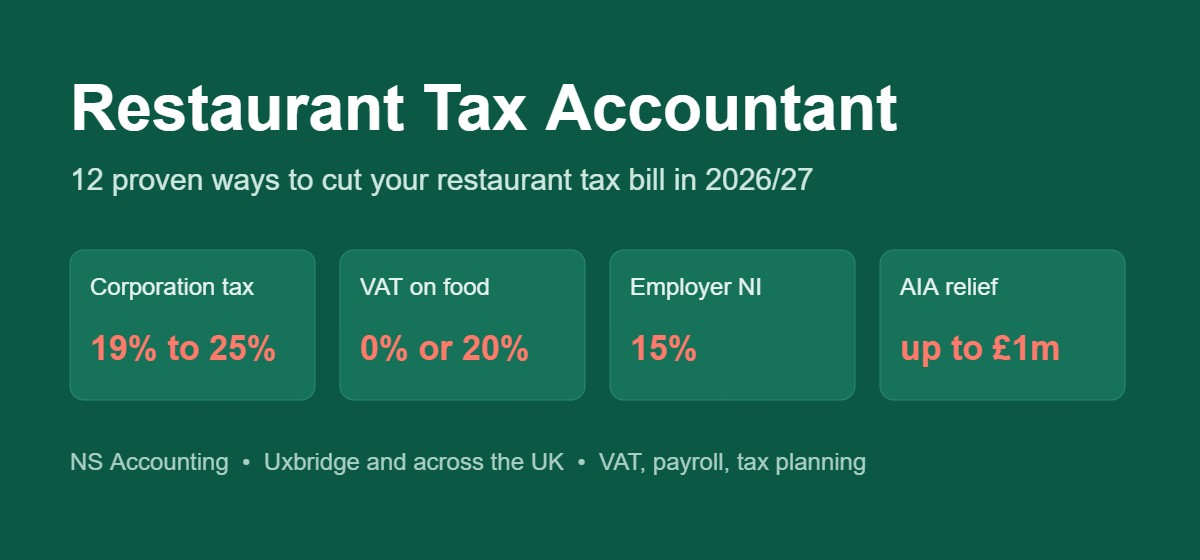
This guide explains 12 proven, legal ways a restaurant tax accountant can reduce your restaurant tax bill in the 2026/27 tax year. It covers corporation tax, VAT, payroll taxes, director pay, capital allowances, business rates and the HMRC risks that restaurants face. If you would rather speak to a specialist straight away, contact NS Accounting today for a free, no obligation consultation.
What Does a Restaurant Tax Accountant Do?
A restaurant tax accountant is a qualified accountant who understands the specific tax rules that apply to food and hospitality businesses. General accountants file your returns. A specialist restaurant tax accountant goes further, planning your tax position before the year ends so you pay the right amount and not a penny more.
A good restaurant tax accountant will:
- Plan your corporation tax or income tax well before your year end
- Get VAT right on hot food, cold food, takeaway, delivery and service charges
- Structure director salary, dividends and pension contributions in the most tax efficient way
- Claim every allowance available on kitchen equipment, fit out and refurbishment
- Manage payroll, tips, tronc and National Insurance correctly
- Protect you from HMRC enquiries, penalties and interest
Our accountants for restaurants service brings all of this together under one fixed monthly fee.
Why Restaurants Pay Too Much Tax in 2026/27
Restaurants are among the most heavily taxed small businesses in the UK. Unlike many retailers, most restaurant sales are standard rated for VAT at 20%. Staff costs are high, and since April 2025 employers pay National Insurance at 15% on earnings above £5,000 per employee. Limited companies with profits above £250,000 pay corporation tax at 25%, while profits between £50,000 and £250,000 fall into marginal relief, which creates an effective rate of 26.5% on that band.
On top of this, dividend tax rates rose by two percentage points from April 2026, to 10.75% at the basic rate and 35.75% at the higher rate. This means the way restaurant directors pay themselves has never mattered more. Without a restaurant tax accountant reviewing your position, it is very easy to lose thousands of pounds a year through missed reliefs, poor timing or simple VAT mistakes.
12 Proven Ways a Restaurant Tax Accountant Can Cut Your Tax Bill
Every restaurant is different, but these are the strategies we use most often with our clients. Each one is fully legal and accepted by HMRC when it is applied correctly.
1. Choose the Right Business Structure
Many restaurants start as sole traders or partnerships and never review that decision. Once profits rise above roughly £50,000, operating through a limited company is often more tax efficient, because profits are taxed at corporation tax rates rather than income tax rates of up to 45%. A limited company also protects your personal assets from business debts, which matters in a sector with leases, supplier credit and staff liabilities.
Your restaurant tax accountant should model both options using your real numbers. If incorporation makes sense, our company formation team can set up your new company and handle the transfer of the business.
2. Get Hot and Cold Food VAT Right
VAT is the single biggest area where restaurants overpay or underpay. Food eaten on your premises is standard rated at 20%. Hot takeaway food is also standard rated. However, many cold takeaway items, such as sandwiches, salads and cold desserts, can be zero rated, as can some cold drinks such as milk based drinks. Restaurants that apply 20% to every sale often hand HMRC money they never needed to pay.
A restaurant tax accountant will review your till settings and menu so each item is coded with the correct VAT rate. Our VAT services cover registration, returns, scheme selection and reviews of past returns to identify overpaid VAT that may be reclaimable.
3. Treat Service Charges and Tips Correctly
Discretionary service charges and tips that customers are free not to pay are generally outside the scope of VAT. A compulsory service charge, however, is part of the price of the meal and is subject to VAT at 20%. Tips paid through a properly run tronc scheme can also be free of employer and employee National Insurance. Getting this wrong can cost a busy restaurant thousands each year. Our guide to tips, service charge and tronc accounting explains the rules in detail.
4. Claim Capital Allowances on Every Piece of Equipment
Ovens, fridges, extraction, coffee machines, furniture, EPOS systems and many parts of a fit out qualify for capital allowances. Limited companies can usually claim the Annual Investment Allowance of up to £1 million, or full expensing on new main rate plant and machinery, giving 100% tax relief in the year of purchase. This can wipe out a large part of your taxable profit in the year you open or refurbish.
Many restaurants miss allowances on fixtures that are built into the property, such as electrical systems, lighting, air conditioning and cold rooms. A restaurant tax accountant will identify these items properly. Read our full guide to capital allowances for restaurants to see what you can claim.
5. Pay Yourself the Most Tax Efficient Way
For restaurant owners who run a limited company, the mix of salary and dividends has a big effect on the total tax you pay. A small director salary is usually set at a level that protects your State Pension record while keeping National Insurance low, with the rest of your income taken as dividends. With the 2026 dividend tax increase, the right balance has shifted, and for some owners extra pension contributions now work better than higher dividends.
Our specialist tax advice service models your options each year so you take home as much as possible.
6. Make Employer Pension Contributions
Employer pension contributions made by your restaurant company are normally an allowable expense for corporation tax and are free of National Insurance. For a director paying higher rate tax, this can be one of the most effective ways to extract profit. Contributions must be wholly and exclusively for the business and within your annual allowance, so a restaurant tax accountant should check the figures before you pay.
7. Use the Employment Allowance and Plan Payroll Costs
Most restaurants with employees can claim the Employment Allowance, which reduces your employer National Insurance bill by up to £10,500 a year. Companies where the director is the only employee paid above the secondary threshold cannot claim it, so the structure of your team matters.
Payroll for hospitality is complex, with variable hours, holiday pay, National Minimum Wage rules and auto enrolment. Our payroll management service handles RTI submissions, payslips, pensions and tronc so you stay compliant and avoid costly penalties.
8. Claim Every Allowable Restaurant Expense
Restaurant owners often forget smaller costs that add up over a year. Allowable expenses can include:
- Food, drink and packaging stock
- Delivery platform commission from Deliveroo, Uber Eats and Just Eat
- Card processing fees and EPOS subscriptions
- Staff uniforms, training and food hygiene certificates
- Repairs, cleaning, pest control and waste collection
- Marketing, website costs and booking system fees
- Accountancy and professional fees
- Staff parties of up to £150 per head per year, which are also tax free for staff
Accurate records are essential for claiming these costs. Our bookkeeping services make sure every receipt and invoice is captured, and you can learn more in our guide to delivery platform accounting for restaurants.
9. Time Your Year End and Big Purchases
When you buy equipment or carry out a refurbishment can change which tax year receives the relief. Bringing forward a planned purchase before your year end can reduce this year’s corporation tax bill and improve cash flow. A restaurant tax accountant will review your management figures two to three months before your year end so there is still time to act. Our restaurant management accounts guide explains how monthly reporting makes this planning possible.
10. Use Losses Wisely
New restaurants often make a loss in their first year because of fit out costs and launch expenses. These losses are valuable. A company can usually carry trading losses forward against future profits, or in some cases carry them back against profits from the previous year to generate a tax refund. Sole traders may be able to set early losses against other income. A restaurant tax accountant will choose the option that produces the best result for you.
11. Check Business Rates and Reliefs
Business rates are not a tax on profit, but they are a major fixed cost. From April 2026, many retail, hospitality and leisure properties benefit from permanently lower business rates multipliers, and smaller properties may also qualify for Small Business Rate Relief. It is also worth checking that your rateable value is correct. While business rates are handled by your local council, a restaurant tax accountant can help you understand the impact on your cash flow and profit. You can check the official rules on the GOV.UK business rates guidance.
12. Stay Ready for Making Tax Digital
From April 2026, sole traders and landlords with qualifying income above £50,000 must keep digital records and send quarterly updates to HMRC under Making Tax Digital for Income Tax. The threshold falls to £30,000 from April 2027. Restaurant owners trading as sole traders need compatible software and a clear process. Our MTD Income Tax accountants can set this up and file your quarterly updates for you.
Restaurant Tax Accountant Example: How Planning Saves Money
Consider a family restaurant in Uxbridge run through a limited company, with annual sales of £850,000 and profit before tax of £120,000. Before working with a restaurant tax accountant, the owner charged VAT at 20% on every takeaway item, took a high salary and claimed no capital allowances on a £40,000 kitchen upgrade.
After a review by NS Accounting:
- Correct VAT coding on cold takeaway items reduced the VAT bill by around £6,000 a year
- Full capital allowances on the kitchen upgrade cut taxable profit by £40,000, saving roughly £10,600 in corporation tax
- A revised salary, dividend and pension plan saved the director around £4,500 in personal tax and National Insurance
- A properly structured tronc scheme removed National Insurance from tips, saving around £3,000
The total saving was more than £24,000 in a single year, far more than the cost of our service. Figures are illustrative and every business is different, which is why personalised advice is so important.
Restaurant Tax Deadlines You Must Not Miss
Missing a deadline leads to automatic penalties and interest. The key dates for restaurant owners are:
| Tax or filing | Deadline |
|---|---|
| VAT returns and payment | One month and seven days after the end of each VAT quarter |
| PAYE and National Insurance | 22nd of each month if paid electronically |
| Corporation tax payment | Nine months and one day after your company year end |
| Company tax return (CT600) | 12 months after your company year end |
| Annual accounts to Companies House | Nine months after your company year end |
| Self Assessment tax return | 31 January after the end of the tax year |
Our statutory accounts and Self Assessment accountants make sure every return is filed on time, every time.
HMRC Risks for Restaurants and How to Stay Protected
HMRC views hospitality as a higher risk sector, mainly because of cash takings, tips and staff turnover. Restaurants are regularly selected for VAT inspections, National Minimum Wage checks and compliance reviews. Common triggers include gross profit margins that look low for the sector, large differences between card and cash sales, and VAT returns that change sharply from quarter to quarter.
A restaurant tax accountant reduces this risk by keeping clean records, reconciling your EPOS, bank and delivery platform reports, and making sure your returns tell a consistent story. If HMRC does open an enquiry, having a specialist on your side makes the process faster and far less stressful.
Tax Support for Cafes, Takeaways and Multi Site Restaurants
The tax issues facing a small cafe are very different from those of a busy takeaway or a growing restaurant group, so your tax plan should reflect how you trade.
Cafes and coffee shops sell a high volume of low value items, many of which can be zero rated when sold cold to take away. Getting till coding right is often the quickest win. Cafes close to the £90,000 VAT registration threshold also need careful monitoring, as registering too late leads to penalties and backdated VAT.
Takeaways usually rely heavily on delivery platforms and cash sales. Reconciling platform payouts, commission and VAT on fees is essential, and strong cash controls protect you during an HMRC check.
Multi site restaurants and groups benefit from group structures, intercompany planning, site by site reporting and careful use of the Annual Investment Allowance, which is shared between companies in the same group. Expansion decisions should always be tested against cash flow and tax before you sign a new lease.
Whatever your format, NS Accounting tailors the plan to your business rather than applying a one size fits all approach.
How to Choose the Right Restaurant Tax Accountant
Not every accountant understands hospitality. When choosing a restaurant tax accountant, look for:
- Proven experience with restaurants, cafes and takeaways
- Clear knowledge of hospitality VAT, tronc and payroll rules
- Proactive tax planning, not just year end compliance
- Cloud accounting expertise with tools such as Xero and QuickBooks
- Fixed monthly fees with no hidden extras
- Local knowledge plus the ability to support businesses across the UK
If you want to understand costs before you decide, our guide to restaurant accountant fees sets out typical UK prices.
Why Choose NS Accounting as Your Restaurant Tax Accountant?
NS Accounting is a trusted firm of accountants based in Uxbridge, supporting restaurants and hospitality businesses across Hillingdon, Ruislip, West Drayton, Hayes, Southall, Ealing, Slough and the rest of the UK. We combine specialist hospitality knowledge with a personal, responsive service. As your restaurant tax accountant, we offer:
- Year round tax planning to reduce corporation tax, VAT and personal tax
- VAT returns with correct treatment of hot food, cold food, delivery and service charges
- Payroll, tronc and pension administration
- Monthly bookkeeping and management accounts
- Year end accounts and company tax returns
- Strategic finance support through our CFO services for growing and multi site restaurants
- Fixed monthly fees agreed in advance
See what our clients say on our testimonials page, learn more about NS Accounting, or meet the team who will look after your restaurant. You can also read our complete guide to restaurant accountants in Uxbridge.
Speak to a Restaurant Tax Accountant Today
Every month without proper tax planning is money your restaurant may never get back. Whether you run a single cafe in Uxbridge, a takeaway in West London or a group of restaurants across the UK, NS Accounting can review your tax position and show you exactly where you could save.
Book your free, no obligation consultation with a restaurant tax accountant at NS Accounting today. Call us, message us on WhatsApp, or get a free quote online, and let us help your restaurant pay less tax and keep more profit.
