

Getting VAT for restaurants right is one of the most important, and most misunderstood, parts of running a food business in the UK. Most restaurant sales are standard rated at 20%, but cold takeaway food can be zero rated, hot food has its own special rules, and service charges, delivery fees and vouchers all need careful treatment. At NS Accounting, we handle VAT for restaurants, cafes, takeaways and hospitality businesses in Uxbridge, Hillingdon, West London and across the UK, and we regularly find restaurants that are overpaying VAT by thousands of pounds a year without realising it.
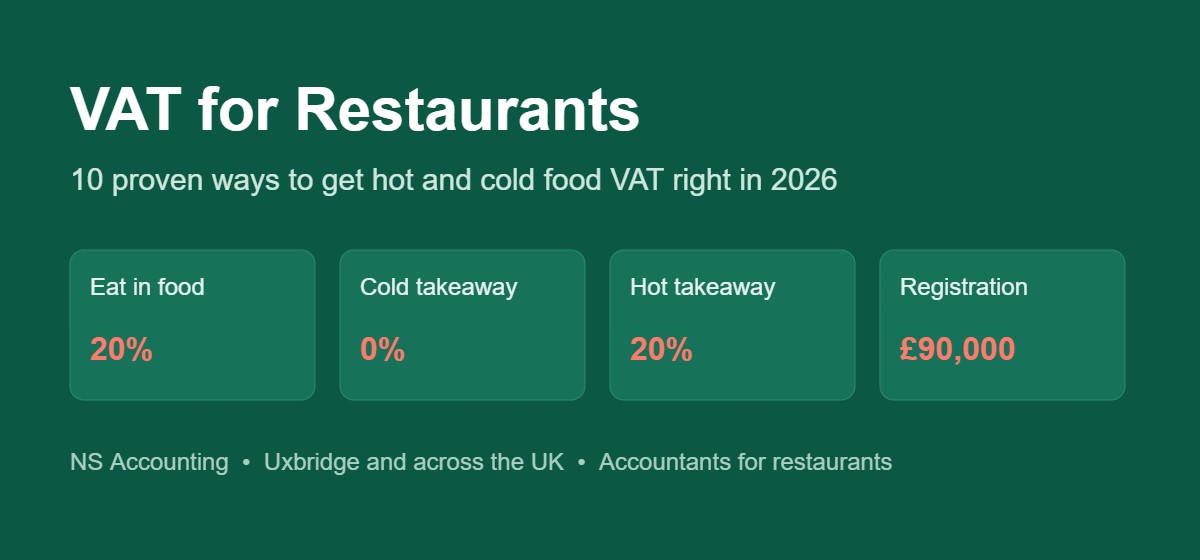
This guide explains how VAT for restaurants works in 2026, which items are standard rated and which are zero rated, which VAT schemes suit restaurants best, and 10 proven ways to cut your VAT bill legally. If you would like a specialist to review your VAT today, contact NS Accounting for a free, no obligation consultation.
How VAT for Restaurants Works in the UK
VAT is a tax on the sale of goods and services. Once your restaurant is VAT registered, you must charge VAT on your taxable sales, known as output tax, and you can reclaim the VAT you pay on most business purchases, known as input tax. Every quarter, you pay HMRC the difference between the two.
The challenge with VAT for restaurants is that most of your purchases, such as fresh food, meat, vegetables and dairy, are zero rated, so you reclaim very little input tax. At the same time, most of your sales are standard rated at 20%. This means restaurants usually pay far more VAT to HMRC than many other types of business, and every coding mistake on your till has a direct effect on your profit.
When Must a Restaurant Register for VAT?
You must register for VAT if your taxable turnover in any rolling 12 month period goes over £90,000, or if you expect it to go over £90,000 in the next 30 days alone. Taxable turnover includes both standard rated and zero rated sales, so cold takeaway sales still count towards the threshold.
Many new restaurants and cafes pass the threshold within their first year without noticing, because they look at their turnover since opening rather than a rolling 12 month total. Registering late means you must pay the VAT you should have charged from the date you were due to register, even if you never collected it from customers. That can wipe out months of profit. Our VAT services include monitoring your turnover each month so you register at exactly the right time.
Standard Rated and Zero Rated Items: VAT for Restaurants Explained
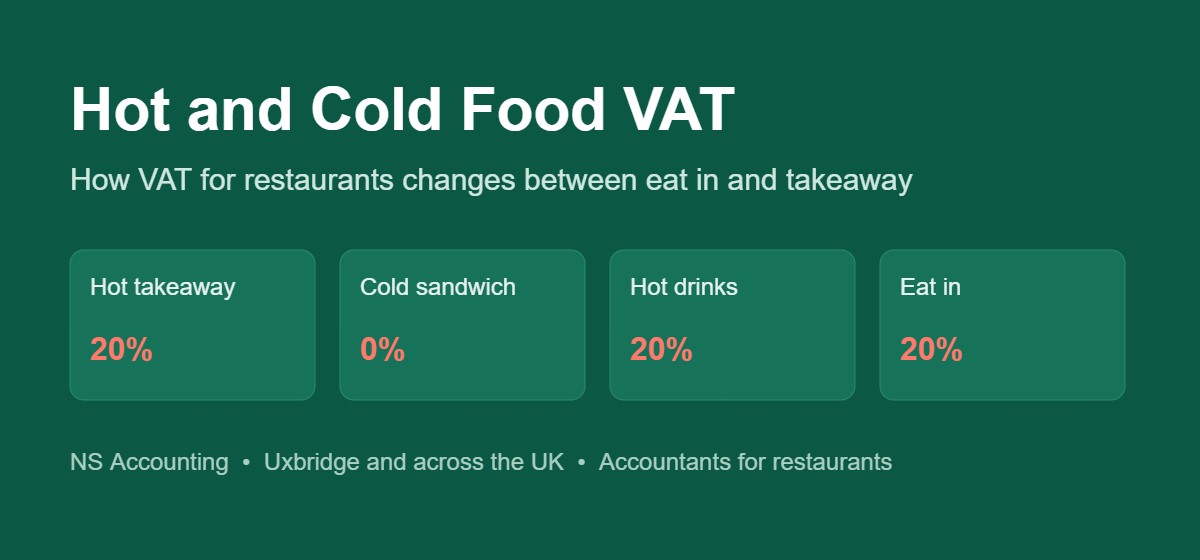
The VAT rate on food depends on what you sell, where it is eaten and whether it is hot or cold. The table below summarises the main rules for VAT for restaurants and cafes.
| Item | Eaten on premises | Takeaway |
|---|---|---|
| Hot meals and hot snacks | 20% | 20% |
| Cold sandwiches, salads and cold meals | 20% | 0% |
| Hot drinks such as tea and coffee | 20% | 20% |
| Cold milk based drinks such as milkshakes | 20% | 0% in many cases |
| Soft drinks, juices and bottled water | 20% | 20% |
| Alcohol | 20% | 20% |
| Crisps, confectionery and ice cream | 20% | 20% |
| Cakes and biscuits, not chocolate covered | 20% | 0% |
Anything eaten on your premises is treated as catering and is standard rated, even if it is cold. Your premises include any tables and chairs you provide, as well as shared seating areas you control, such as in a food court. This is why many cafes ask customers whether they are eating in or taking away, because the answer changes the VAT due.
What Counts as Hot Food for VAT?
Hot takeaway food is standard rated if it has been heated to enable it to be eaten hot, is kept hot after cooking, or is advertised or supplied as hot food. Fish and chips, pizzas, burgers, curries and hot pies sold to take away are all standard rated. However, freshly baked bread or pastries that are simply still warm from the oven, and are not sold specifically to be eaten hot, can often be zero rated.
The hot food rules are one of the most disputed areas of VAT for restaurants and have been the subject of many tribunal cases. If you sell items that sit near the line, such as rotisserie chicken, toasted sandwiches or baked goods kept in a heated cabinet, it is worth taking specialist advice so your till is set up correctly.
Choosing the Best VAT Scheme for Your Restaurant
HMRC offers several VAT accounting schemes, and each one treats VAT for restaurants slightly differently. Choosing the right one is a key part of managing VAT for restaurants efficiently.
Standard VAT Accounting
Under the standard method, you pay VAT on sales based on the date of the invoice or sale, and reclaim VAT on purchases based on the date of the purchase invoice. Most restaurants use this method, and it allows you to reclaim VAT on equipment, refurbishment and other costs in full.
Flat Rate Scheme
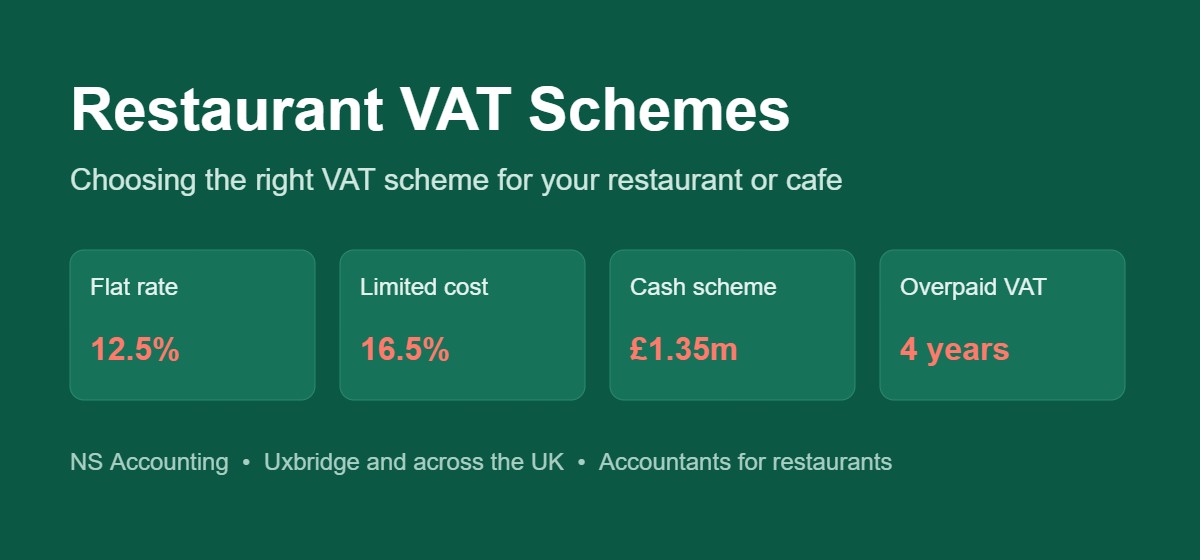
The Flat Rate Scheme lets smaller businesses pay a fixed percentage of their gross turnover to HMRC rather than calculating input and output VAT. The flat rate for catering services, including restaurants and takeaways, is 12.5%, rising to 16.5% if you are a limited cost trader. Because a large share of restaurant sales can be zero rated takeaway food, the Flat Rate Scheme can work out more expensive for some businesses, as the flat rate applies to zero rated sales too. A careful comparison is essential before you join.
Cash Accounting Scheme
With cash accounting, you pay VAT when your customers pay you and reclaim VAT when you pay your suppliers. For most restaurants, customers pay immediately, so the main benefit comes from events, corporate catering and outside catering where invoices are paid later. You can use the scheme if your taxable turnover is £1.35 million or less.
Annual Accounting Scheme
The Annual Accounting Scheme lets you submit one VAT return a year and make advance payments in instalments. It can help with budgeting, but it can also hide problems until the year end, so it is less common for restaurants.
10 Proven Ways to Reduce VAT for Restaurants Legally
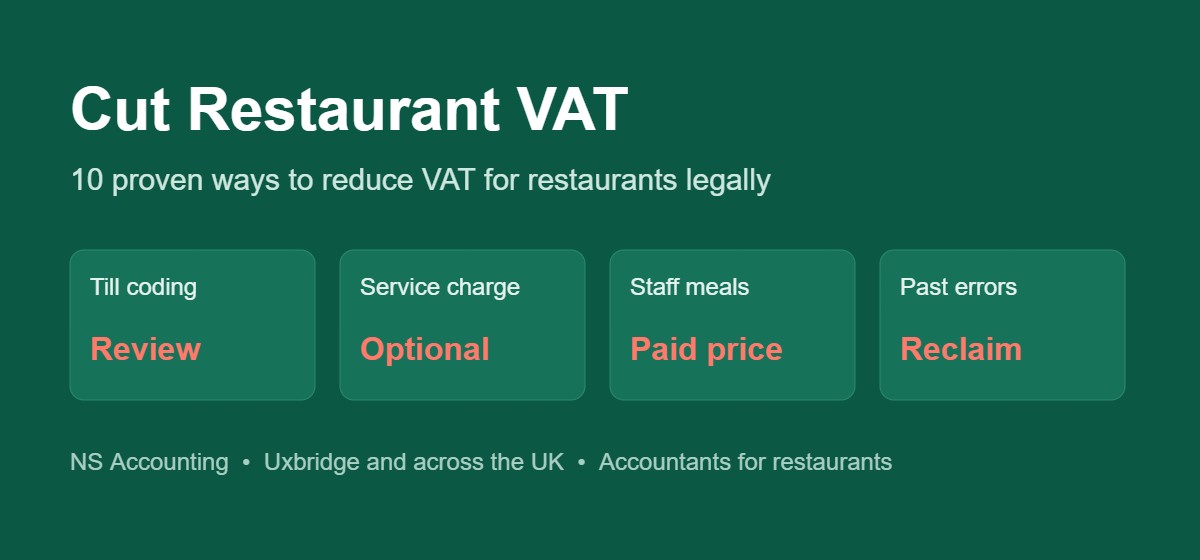
The following VAT for restaurants strategies are used by our team every week to help restaurant owners pay the correct amount of VAT and nothing more.
1. Code Every Menu Item Correctly on Your EPOS
Your EPOS or till system decides how much VAT you pay. If every takeaway item is coded at 20%, you could be overpaying on cold sandwiches, salads, cakes and milkshakes. We review your menu line by line and set up the correct VAT codes for eat in and takeaway sales.
2. Separate Eat In and Takeaway Sales
Make sure your staff ask customers whether they are eating in or taking away, and that your till records the answer. Clear records protect you if HMRC challenges your VAT for restaurants calculations during an inspection.
3. Treat Service Charges Correctly
A genuinely optional service charge or tip is outside the scope of VAT. A compulsory service charge, such as one automatically added for large groups, is part of the price and is subject to VAT at 20%. Changing how a service charge is presented on your menu and bill can make a significant difference. Our guide to tips, service charge and tronc accounting explains the rules in more detail.
4. Reclaim VAT on All Eligible Purchases
Although most food is zero rated, many restaurant costs carry VAT that you can reclaim, including kitchen equipment, furniture, refurbishment, cleaning products, packaging, utilities, professional fees, software and delivery platform commission. Make sure you keep valid VAT invoices for every purchase. Our bookkeeping services capture every invoice so no reclaimable VAT is missed.
5. Get Delivery Platform VAT Right
When you sell through Deliveroo, Uber Eats or Just Eat, you are usually still the seller of the food, so you must account for VAT on the full price paid by the customer, not just the amount the platform pays you. The commission the platform charges you normally carries VAT, which you can reclaim with a valid invoice. Read our guide to delivery platform accounting for restaurants for a full breakdown.
6. Review Whether the Flat Rate Scheme Still Suits You
Many restaurants join the Flat Rate Scheme when they first register and never review it. As your mix of eat in and takeaway sales changes, the scheme can become more expensive. We compare your actual VAT under each scheme so you can switch if it saves money.
7. Handle Vouchers and Gift Cards Properly
Gift vouchers that can only be used for one type of supply at one VAT rate are usually taxed when sold, while vouchers that can be used for items at different VAT rates are usually taxed when redeemed. Getting this wrong leads to errors in your VAT for restaurants returns, especially around Christmas and Mother’s Day.
8. Account for Staff Meals Correctly
Free meals provided to staff generally do not create a VAT charge. If staff pay a reduced price for meals, VAT is due only on the amount they actually pay. Many restaurants overpay by charging VAT on the full menu price of staff meals.
9. Time Large Purchases Around Your VAT Quarters
If you are planning a refurbishment or buying expensive equipment, the timing of the invoice affects which VAT return includes the reclaim. A well timed purchase can improve your cash flow significantly. Larger purchases may also qualify for capital allowances, as explained in our guide to capital allowances for restaurants.
10. Correct Past Errors Before HMRC Finds Them
If you discover you have overpaid VAT in previous periods, you can usually claim it back for up to four years. If you have underpaid, correcting the error voluntarily usually means lower penalties. Small errors below the error correction threshold can often be corrected on your next VAT return.
Making Tax Digital and VAT for Restaurants
All VAT registered businesses must keep digital records and submit VAT returns using Making Tax Digital compatible software. For VAT for restaurants, this means your EPOS, delivery platform reports, bank feeds and purchase invoices should flow into cloud accounting software such as Xero, QuickBooks or Sage. Manual spreadsheets copied by hand create errors and make it harder to defend your figures. We set up and manage this digital link for our restaurant clients so returns are accurate and filed on time.
VAT Penalties and HMRC Inspections
Since January 2023, HMRC uses a points based system for late VAT returns. Each late return earns a penalty point, and once you reach the threshold, you receive a £200 penalty for that and each further late return. Late payments also attract penalties and interest, which increase the longer the VAT stays unpaid.
HMRC treats hospitality as a higher risk sector for VAT because of cash sales and the complexity of the food rules. Inspectors often compare your gross profit margin with similar restaurants, test your eat in and takeaway split, and review your EPOS data. Accurate records and a specialist who understands VAT for restaurants are your best protection. Our specialist tax advice team can represent you if HMRC opens an enquiry.
A Worked Example of VAT for Restaurants
Consider a busy cafe in Uxbridge with annual sales of £300,000, of which £120,000 are takeaway sales. Before working with NS Accounting, the owner charged 20% VAT on all sales, including cold sandwiches, salads and cakes sold to take away.
After a review, we found that around £70,000 of takeaway sales could be zero rated. At the VAT fraction of one sixth, that meant the cafe had been paying roughly £11,600 too much VAT each year. We corrected the till coding going forward and helped the owner submit a claim for overpaid VAT in previous periods. Figures are illustrative, but savings of this size are common when VAT for restaurants has not been reviewed by a specialist.
Common Mistakes With VAT for Restaurants
These are the VAT for restaurants mistakes we see most often when new clients join us:
- Charging 20% VAT on every takeaway item, including zero rated cold food
- Recording only the net payout from delivery platforms instead of the gross sale
- Treating compulsory service charges as outside the scope of VAT
- Missing the £90,000 registration threshold because turnover was not tracked on a rolling basis
- Staying on the Flat Rate Scheme when it no longer saves money
- Losing purchase invoices, which means VAT cannot be reclaimed
- Filing returns late and building up penalty points
Each of these mistakes is avoidable with the right systems and a regular review of your VAT for restaurants position.
VAT for Restaurants, Cafes and Takeaways: Different Businesses, Different Risks
Not every food business faces the same issues with VAT for restaurants. Sit down restaurants make mostly standard rated sales, so the focus is on reclaiming every bit of input tax and handling service charges correctly. Cafes and coffee shops have a large share of takeaway sales, so the eat in and takeaway split and correct coding of cold food make the biggest difference. Takeaways sell mostly hot food at 20%, so delivery platform VAT, packaging costs and cash controls matter most.
Whatever type of food business you run, we tailor our approach to VAT for restaurants to the way you actually trade. If you are just opening, our restaurant startup accounting guide explains how to set up VAT from day one, and our company formation service can set up your limited company.
How NS Accounting Helps With VAT for Restaurants
NS Accounting is a firm of accountants based in Uxbridge, supporting restaurants, cafes and takeaways across Hillingdon, Ruislip, Hayes, West Drayton, Southall, Ealing, Slough and the rest of the UK. Our support with VAT for restaurants includes:
- VAT registration and choosing the right VAT scheme
- EPOS and menu reviews to code every item at the correct rate
- Quarterly VAT returns filed through Making Tax Digital software
- Delivery platform reconciliation and VAT on commission
- Reviews of past returns and claims for overpaid VAT
- Support during HMRC VAT inspections
- Linked payroll management, statutory accounts and Self Assessment services
Our accountants for restaurants service brings all of this together for one fixed monthly fee. You can read about typical costs in our guide to restaurant accountant fees, see what clients say on our testimonials page, or meet the team. For official guidance, you can also read HMRC’s VAT Notice 709/1 on catering and takeaway food.
Get Expert Help With VAT for Restaurants Today
Every quarter your till is coded incorrectly is money your restaurant may never recover, which is why VAT for restaurants deserves specialist attention. Whether you run a single cafe in Uxbridge, a takeaway in West London or a group of restaurants across the UK, NS Accounting can review your VAT and show you exactly where you could save.
Book your free, no obligation VAT review with NS Accounting today. Call us, message us on WhatsApp or get a free quote online, and let our specialists make VAT for restaurants simple, accurate and as low as the law allows.
