

Getting restaurant payroll right is one of the biggest challenges for any food business in the UK. Hospitality teams work variable hours, split shifts, late nights and weekends, staff turnover is high, and tips, holiday pay and National Minimum Wage rules all add complexity. A single mistake can lead to HMRC penalties, unhappy staff or even being publicly named for underpaying wages. At NS Accounting, we manage restaurant payroll for restaurants, cafes, takeaways and hospitality businesses in Uxbridge, Hillingdon, West London and across the UK, so owners can focus on their customers instead of payslips.

This guide explains how restaurant payroll works in 2026/27, the key wage rates and employer costs, the rules on tips, holiday pay and pensions, and 9 proven ways to keep your restaurant payroll accurate, compliant and affordable. If you would like a specialist to take payroll off your hands, contact NS Accounting for a free, no obligation consultation.
What Is Restaurant Payroll?
Restaurant payroll is the process of calculating and paying your staff correctly every week or month, deducting the right amount of tax and National Insurance, and reporting everything to HMRC in real time. It also covers workplace pensions, statutory payments such as sick pay and maternity pay, holiday pay, tips and staff records.
For most restaurants, staff costs are the largest expense after food, typically between 25% and 35% of sales. That makes restaurant payroll both a compliance task and a profit task. Paying people accurately keeps you on the right side of the law, while controlling labour costs keeps your restaurant profitable.
Key Restaurant Payroll Rates for 2026/27
The table below shows the main rates that affect restaurant payroll from April 2026.
| Rate or threshold | 2026/27 figure |
|---|---|
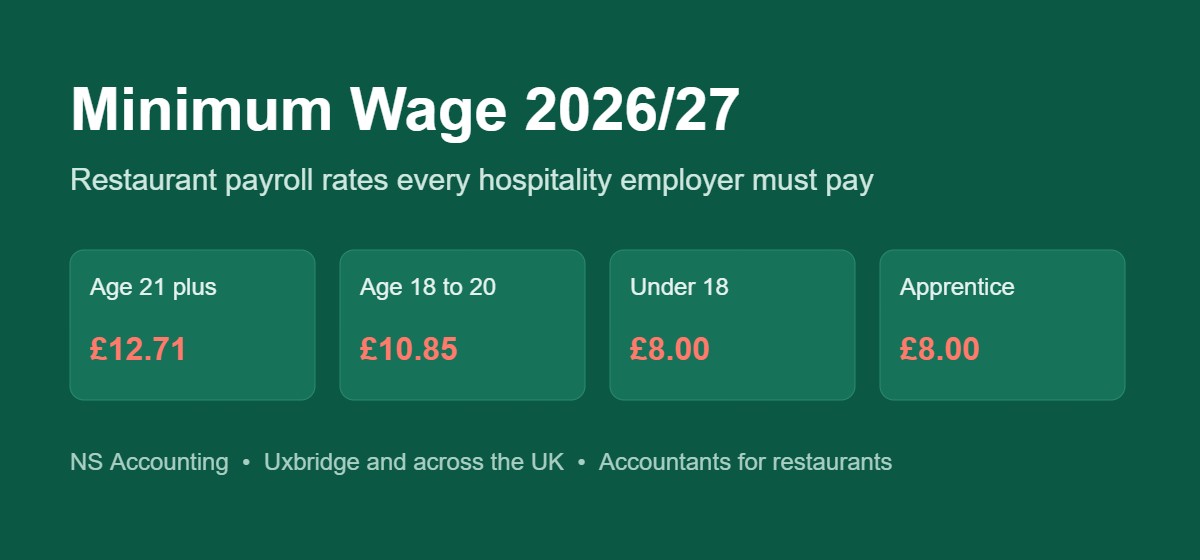
| National Living Wage, age 21 and over | £12.71 per hour |
| National Minimum Wage, age 18 to 20 | £10.85 per hour |
| Under 18 and apprentice rate | £8.00 per hour |
| Employer National Insurance | 15% above £5,000 a year per employee |
| Employment Allowance | Up to £10,500 a year |
| Auto enrolment earnings trigger | £10,000 a year |
| Minimum pension contributions | 8% in total, at least 3% from the employer |
These figures change every April, so your restaurant payroll software and processes must be updated at the start of each tax year. Our payroll management service handles these updates automatically for every client.
Why Restaurant Payroll Is More Complex Than Other Payroll
Most office businesses pay the same salary to the same people every month. Restaurant payroll is very different. Hours change every week depending on bookings, many staff work part time or on zero hours contracts, and students and seasonal workers join and leave throughout the year. On top of this, restaurants must deal with tips and service charges, staff meals, uniforms, late night shifts and frequent overtime.
Each of these factors creates a risk of error. Underpaying someone by even a few pence per hour below the minimum wage is a breach of the law, and HMRC actively targets hospitality for minimum wage checks. That is why many restaurant owners choose to outsource restaurant payroll to a specialist accountant.
National Minimum Wage Rules Every Restaurant Must Know
The National Minimum Wage is calculated on the average hourly pay for the time worked in each pay period. In restaurants, several common practices can push pay below the legal minimum without owners realising.
Unpaid Trial Shifts
Asking a candidate to work a trial shift for free is usually unlawful if they are doing real work. Trial shifts should be paid at least the minimum wage.
Deductions for Uniforms and Equipment
If staff pay for their own uniform, knives or shoes, or you deduct the cost from wages, this can reduce their pay below the minimum wage for that period. Restaurant payroll must take these deductions into account.
Time Before and After Shifts
Time spent setting up before opening, cleaning after closing, attending training or waiting for a delivery counts as working time. If it is not recorded and paid, your restaurant payroll may be underpaying staff.
Tips Do Not Count Towards Minimum Wage
Tips, gratuities and service charges cannot be used to top up pay to the minimum wage. The basic hourly rate itself must meet the legal minimum.

Tips, Service Charges and the Tipping Law
Since 1 October 2024, the Employment (Allocation of Tips) Act requires employers to pass on all tips, gratuities and service charges to workers in full, without deductions other than tax. You must have a written tipping policy, distribute tips fairly and keep records for three years. Workers can ask to see your tipping records.
How you pay tips affects your restaurant payroll costs. Tips paid through a properly run tronc scheme, where an independent troncmaster decides how they are shared, are subject to income tax but can be free of National Insurance for both employer and employee. Tips paid directly through payroll by the employer usually attract National Insurance. Our guide to tips, service charge and tronc accounting explains how to set up a compliant tronc scheme.
Holiday Pay for Restaurant Staff
All workers, including part time and zero hours staff, are entitled to 5.6 weeks of paid holiday each year. For workers with irregular hours or part year contracts, employers can calculate holiday entitlement as 12.07% of hours worked in each pay period, and can use rolled up holiday pay, where holiday pay is added to each payslip, for leave years starting on or after 1 April 2024.
Holiday pay must include regular overtime and certain allowances for the first four weeks of leave. Getting holiday pay wrong is one of the most common restaurant payroll errors and can lead to claims at an employment tribunal.
Auto Enrolment Pensions in Restaurants
Every employer must enrol eligible staff into a workplace pension. Workers aged 22 to State Pension age who earn more than £10,000 a year must be enrolled automatically, and others can ask to join. Total minimum contributions are 8% of qualifying earnings, with at least 3% from the employer.
Because restaurant staff hours change, workers can move in and out of eligibility from one pay period to the next. Your restaurant payroll system must assess every worker every time you run payroll, and you must complete a declaration of compliance with The Pensions Regulator.
Statutory Sick Pay and Other Statutory Payments
Restaurant payroll also includes statutory payments such as Statutory Sick Pay, Statutory Maternity Pay and Statutory Paternity Pay. From April 2026, changes under the Employment Rights Act mean Statutory Sick Pay is payable from the first day of sickness, and the lower earnings limit for eligibility has been removed, so more part time hospitality workers now qualify. Restaurants should review their sickness policies and budgets to reflect this change.
Real Time Information and HMRC Deadlines
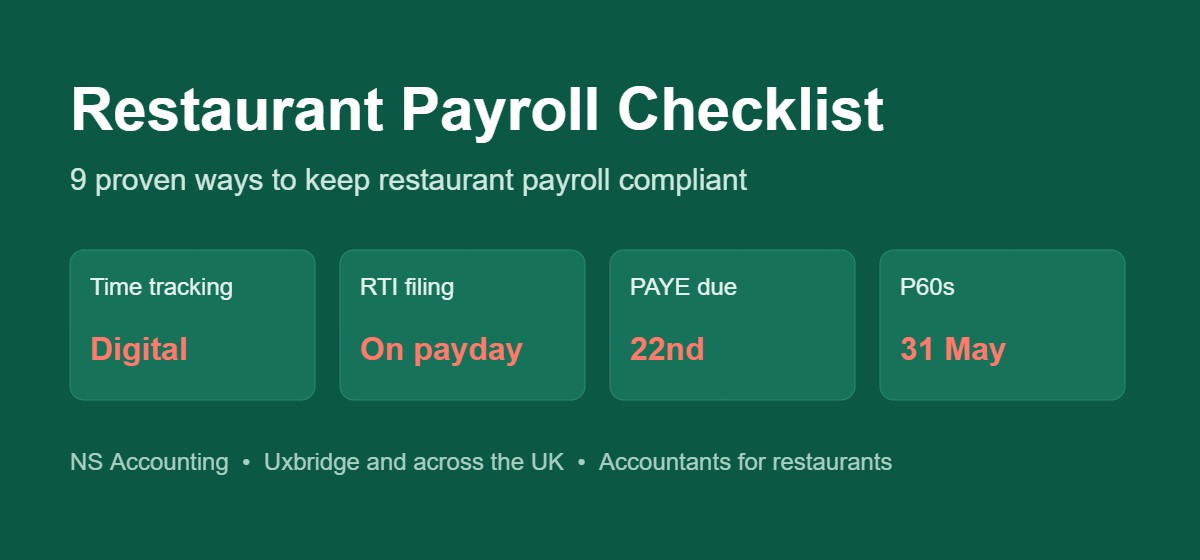
Every time you pay staff, you must send a Full Payment Submission to HMRC on or before payday. You must also pay the PAYE and National Insurance you owe to HMRC by the 22nd of the following month if paying electronically. At the end of the tax year, every employee must receive a P60 by 31 May, and any benefits in kind must be reported by 6 July.
Late submissions and payments attract automatic penalties. For a restaurant with a large team, these can quickly add up. Our team files every restaurant payroll submission on time, every time.
9 Proven Ways to Get Restaurant Payroll Right
These are the steps we put in place for every restaurant payroll client.
1. Use Digital Time Tracking
Clock in systems linked to your EPOS or rota software record actual hours worked, including set up and close down time. Accurate hours are the foundation of accurate restaurant payroll.
2. Check Minimum Wage Compliance Every Pay Run
We check each worker’s average hourly rate against the correct age band in every pay period, taking deductions and unpaid time into account.
3. Set Up a Compliant Tronc Scheme
A properly structured tronc scheme can save National Insurance on tips while meeting the tipping law. This is often one of the largest savings available in restaurant payroll.
4. Claim the Employment Allowance
Most restaurants with employees can reduce their employer National Insurance bill by up to £10,500 a year. Make sure it is claimed at the start of each tax year.
5. Get Right to Work Checks Done Before Day One
Employers must check every worker’s right to work in the UK before they start. Civil penalties for employing someone without the right to work can reach £60,000 per worker, and hospitality is a sector HMRC and the Home Office actively check. Keep copies of every check.
6. Plan Rotas Against Sales Forecasts
Labour is a cost you can control. Matching rotas to expected covers keeps your wage percentage on target. Our restaurant management accounts show your labour cost as a percentage of sales every month.
7. Pay Directors Tax Efficiently
If you run your restaurant through a limited company, your own salary is part of restaurant payroll too. A small director salary combined with dividends and pension contributions is usually the most tax efficient approach. Our specialist tax advice team can model the best mix for you.
8. Keep Clear Staff Records
Employment contracts, holiday records, tip records, pension letters and right to work documents should be stored securely and kept for the required periods.
9. Outsource to a Restaurant Payroll Specialist
Outsourcing restaurant payroll removes the risk of errors, saves hours of admin each week and gives you access to expert advice whenever rules change.
Employment Status: Employees, Workers and Self Employed Staff
Not everyone who works in your kitchen or front of house is automatically self employed, even if they ask to be paid that way. Chefs, waiters, kitchen porters and bar staff who work set shifts, follow your instructions and use your equipment are almost always employees or workers. Treating them as self employed can lead to backdated tax, National Insurance, holiday pay and pension contributions, plus penalties.
Delivery drivers and freelance chefs need careful review. Some genuinely run their own business, while others are employees in practice. HMRC looks at the reality of the working relationship, not the label on the contract, so it is worth getting advice before you agree terms.
Staff Meals, Uniforms and Benefits
Many restaurants provide free or discounted meals during shifts. Meals provided in a staff canteen or on the premises for all staff are generally tax free, but cash allowances for food are taxable. Uniforms that carry your logo and are only suitable for work are usually tax free, while ordinary clothing given to staff can be a taxable benefit.
Small gifts of up to £50, such as a bottle of wine or a voucher, can usually be given tax free under the trivial benefits rules, as long as they are not a reward for work. An annual staff party of up to £150 per head is also tax free. These small extras help with staff retention without creating extra tax costs.
Agency Staff and Seasonal Workers
Busy periods such as Christmas, summer and major events often mean using agency staff or hiring seasonal workers. Agency workers are usually paid by the agency, but you are still responsible for providing safe working conditions, and after 12 weeks in the same role they gain the right to equal basic pay and conditions. Seasonal workers you employ directly must go through payroll in the normal way, with the correct tax code, minimum wage and holiday entitlement.
Planning ahead for seasonal peaks helps you avoid paying expensive overtime or agency fees at short notice. Your accountant can use last year’s figures to forecast staffing needs and costs for the year ahead.
Choosing Payroll Software for Your Restaurant
Good software makes payroll faster and safer. Look for a system that is recognised by HMRC, handles weekly and monthly pay runs, assesses workers for auto enrolment automatically and connects with your rota or time tracking app. Cloud accounting packages such as Xero and QuickBooks include payroll features, and dedicated hospitality rota tools can export hours directly into them. We help clients choose and set up the right combination so information only needs to be entered once.
A Restaurant Payroll Example
Consider a restaurant in Uxbridge with 18 staff and an annual wage bill of £320,000. Before working with NS Accounting, the owner ran payroll on a basic spreadsheet, paid tips through payroll with National Insurance deducted, and had not claimed the Employment Allowance.
After we took over restaurant payroll, we set up a compliant tronc scheme, claimed the Employment Allowance and introduced digital time tracking. The restaurant saved around £10,500 through the Employment Allowance and several thousand pounds more in National Insurance on tips, while removing the risk of minimum wage errors. Figures are illustrative, but results like these are common for restaurants that have never had a restaurant payroll review.
Common Restaurant Payroll Mistakes
- Not paying for trial shifts, training or time spent setting up and closing
- Using tips to top up wages to the minimum wage
- Paying the wrong minimum wage rate after a worker’s birthday
- Calculating holiday pay without overtime
- Failing to assess workers for auto enrolment every pay period
- Filing Full Payment Submissions late
- Missing right to work checks for new starters
Restaurant Payroll for Cafes, Takeaways and Multi Site Groups
Small cafes often have just a few staff but many students and part time workers, so minimum wage age bands and auto enrolment checks are the main risk. Takeaways frequently employ delivery drivers, which raises questions about mileage, vehicle costs and employment status. Restaurant groups need restaurant payroll reporting by site, so owners can compare labour costs across locations and make better decisions. Whatever your format, we tailor restaurant payroll to the way your business works. Larger groups can also benefit from our CFO services for strategic labour planning.

Why Choose NS Accounting for Restaurant Payroll?
NS Accounting is a firm of accountants based in Uxbridge, supporting restaurants, cafes and takeaways across Hillingdon, Ruislip, Hayes, West Drayton, Southall, Ealing, Slough and the rest of the UK. Our restaurant payroll service includes:
- Weekly, fortnightly or monthly payroll with payslips for every worker
- RTI submissions to HMRC and PAYE payment reminders
- Minimum wage, holiday pay and tronc compliance checks
- Auto enrolment pension administration
- Starters, leavers, P45s, P60s and P11Ds
- Linked bookkeeping, VAT returns, statutory accounts and Self Assessment
Our accountants for restaurants service brings everything together for one fixed monthly fee. You can read about costs in our guide to restaurant accountant fees, read our client testimonials or meet the team. For the latest official wage rates, see the GOV.UK National Minimum Wage rates page.
Hand Your Restaurant Payroll to the Experts Today
Every pay run that goes wrong costs you time, money and staff goodwill. Whether you run a single cafe in Uxbridge, a takeaway in West London or a group of restaurants across the UK, NS Accounting can take over your restaurant payroll and make sure every worker is paid correctly and on time.
Book your free, no obligation restaurant payroll review with NS Accounting today. Call us, message us on WhatsApp or get a free quote online, and let us take restaurant payroll off your plate for good.
