

Every limited company restaurant in the UK must prepare restaurant year end accounts, file them with Companies House and HMRC, and pay the right amount of corporation tax on time. For sole traders and partnerships, year end figures form the basis of your Self Assessment tax return. Many owners treat the year end as a stressful paperwork exercise, but well prepared restaurant year end accounts are also one of the best opportunities to reduce tax, understand your profit and plan the year ahead. At NS Accounting, we prepare restaurant year end accounts for restaurants, cafes, takeaways and hospitality businesses in Uxbridge, Hillingdon, West London and across the UK.

This guide explains what restaurant year end accounts include, the key deadlines and penalties, the year end adjustments that matter most for restaurants, and 10 proven steps to file on time and pay less tax in 2026. If your year end is approaching, contact NS Accounting for a free, no obligation consultation.
What Are Restaurant Year End Accounts?
Restaurant year end accounts, also called annual or statutory accounts, are a formal summary of your restaurant’s financial performance and position over a 12 month accounting period. For a limited company, they usually include:
- A profit and loss account showing sales, costs and profit
- A balance sheet showing assets, liabilities and shareholders’ funds
- Notes to the accounts explaining key figures and accounting policies
- A directors’ report, unless the company qualifies for an exemption
Small and micro companies can file simplified versions with Companies House, but full figures are still needed to calculate corporation tax. Our statutory accounts service prepares and files every part for you.
Restaurant Year End Accounts Deadlines
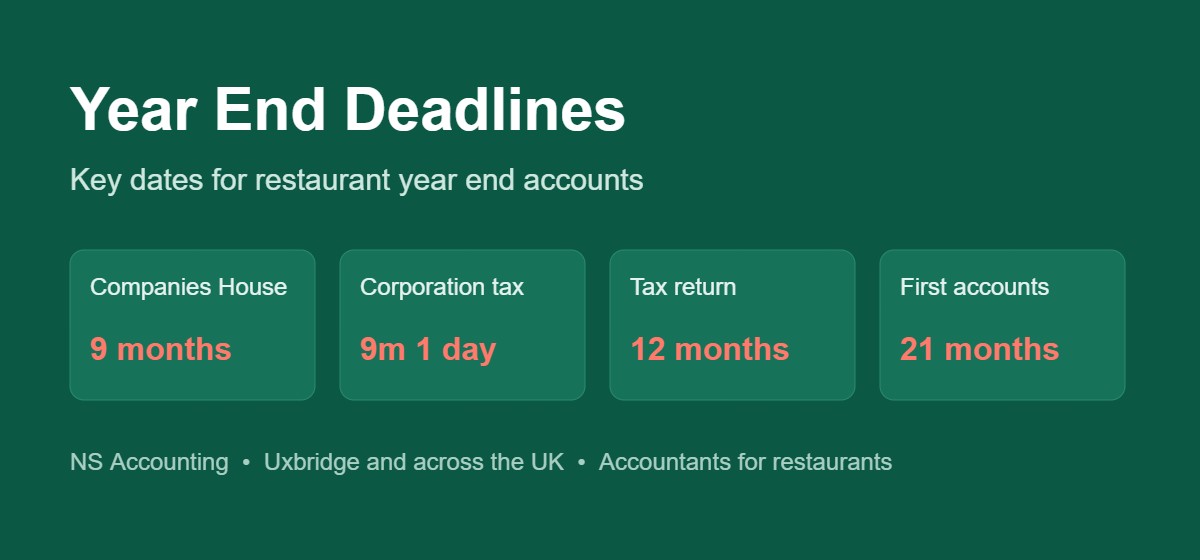
Missing a deadline leads to automatic penalties, so it is important to know each date. The table below shows the main deadlines for a limited company restaurant.
| Requirement | Deadline |
|---|---|
| File accounts with Companies House | Nine months after the year end |
| Pay corporation tax | Nine months and one day after the year end |
| File company tax return (CT600) | 12 months after the year end |
| Confirmation statement | At least once every 12 months |
| Directors’ Self Assessment returns | 31 January after the end of the tax year |
A company’s first accounts have different deadlines, usually 21 months from the date of incorporation, so new restaurants should check their dates carefully.
Penalties for Late Restaurant Year End Accounts
Companies House charges automatic penalties for late accounts, starting at £150 for accounts up to one month late and rising to £1,500 for accounts more than six months late. Penalties double if accounts are filed late two years in a row. HMRC charges a £100 penalty for a late company tax return, a further £100 if it is three months late, and additional tax based penalties for longer delays. Interest is also charged on late corporation tax. Filing restaurant year end accounts on time avoids all of these costs.
Corporation Tax for Restaurants in 2026
Corporation tax is charged on your company’s taxable profit. From April 2023, the main rate is 25% for profits above £250,000, and the small profits rate is 19% for profits up to £50,000. Profits between these limits pay a rate between the two through marginal relief, with an effective rate of 26.5% on the profit in that band. The limits are reduced if your company has associated companies, such as other restaurant companies under common control.
Taxable profit is not the same as accounting profit. Depreciation is added back and replaced by capital allowances, and some costs, such as client entertaining, are not allowable. Getting these adjustments right is a key part of preparing restaurant year end accounts.

Key Year End Adjustments for Restaurants
Restaurants have several items that need careful treatment at the year end. Each one affects your profit and your tax bill.
Stock Count
Food, drink and packaging in stock at the year end must be counted and valued. Wine and spirits are often the largest stock items. An accurate stock count is essential, because a lower stock figure reduces profit and a higher one increases it. HMRC may question stock values that seem unusually low.
Accruals and Prepayments
Costs that relate to the year but have not yet been invoiced, such as utilities, are added as accruals. Costs paid in advance, such as rent or insurance covering the next year, are treated as prepayments. These adjustments make sure each year shows the right costs.
Gift Vouchers and Deposits
Gift vouchers sold but not yet redeemed, and deposits received for future bookings or events, are usually liabilities rather than sales at the year end. Treating them correctly avoids overstating profit.
Tips and Tronc Balances
Tips collected but not yet paid out to staff belong to the staff, not the restaurant, and should be shown as a liability. Our guide to tips, service charge and tronc accounting explains the rules.
Capital Allowances
Kitchen equipment, furniture, EPOS systems and fit out costs bought during the year may qualify for the Annual Investment Allowance or full expensing, giving 100% tax relief. Read our guide to capital allowances for restaurants for more detail.
Director Loan Accounts
If you have taken more money out of the company than you have been paid in salary and dividends, you may have an overdrawn director loan account. If it is not repaid within nine months of the year end, the company must pay extra tax of 33.75% of the outstanding balance, which is refunded only when the loan is repaid. Reviewing your director loan account before the year end avoids this charge.

10 Proven Steps to Prepare Restaurant Year End Accounts
These are the steps we follow with every restaurant client.
1. Keep Bookkeeping Up to Date All Year
Restaurant year end accounts are only as good as the records behind them. Monthly bookkeeping makes the year end quick and accurate. Our bookkeeping services keep your records current.
2. Review Profit Three Months Before the Year End
A review two to three months before your year end gives time to plan purchases, pension contributions and dividends.
3. Plan Equipment Purchases
Buying planned equipment before the year end can bring forward tax relief into the current year.
4. Make Employer Pension Contributions
Employer pension contributions paid before the year end are usually deductible for corporation tax and free of National Insurance.
5. Plan Director Pay and Dividends
Dividends can only be paid from available profits. Plan salary and dividends so you use your personal allowances and basic rate band efficiently. Our specialist tax advice team can model the options.
6. Count and Value Stock Accurately
Count stock on the last day of the year, record quantities and use cost price, not selling price.
7. Reconcile Every Bank, Card and Delivery Account
Make sure your bank, card provider and delivery platform balances agree with your records.
8. Review VAT and Payroll Balances
Check that VAT and PAYE liabilities in the balance sheet match what is owed to HMRC.
9. Gather Fixed Asset Details
Keep invoices for all equipment and refurbishment, so capital allowances can be claimed correctly.
10. File Early and Plan the Tax Payment
Filing early gives you certainty about your tax bill and time to plan the payment. It also reduces stress during busy trading periods and lets you focus on running your restaurant.
Restaurant Year End Accounts for Sole Traders and Partnerships
Sole traders and partnerships do not file accounts at Companies House, but they still need accurate year end figures to complete Self Assessment tax returns. From 2024/25, profits are taxed on a tax year basis, meaning profits are measured for the tax year from 6 April to 5 April, even if your accounting year ends on a different date. Choosing a 31 March or 5 April year end often makes things simpler.
From April 2026, sole traders with qualifying income above £50,000 must also send quarterly updates under Making Tax Digital for Income Tax, and then submit a final declaration after the year end. Our Self Assessment accountants and MTD Income Tax accountants can handle every step.
How Long Does It Take to Prepare Restaurant Year End Accounts?
If your bookkeeping is up to date and the year end information is ready, restaurant year end accounts can often be prepared within a few weeks. Where records are incomplete, bank accounts have not been reconciled or invoices are missing, the process takes much longer and costs more. Planning a timetable with your accountant, including the date of the stock count, the date for sending information and a target filing date, keeps everything on track and gives you plenty of notice of your corporation tax bill.
Using Restaurant Year End Accounts to Improve Your Business
Restaurant year end accounts are more than a compliance task. They show your gross profit margin, wage percentage, overheads and net profit for the whole year. Comparing these with previous years and with sector benchmarks highlights what is working and what needs attention.
Many restaurants use their year end review to set budgets for the next year, plan price changes and decide whether to invest in refurbishment or a new site. Combined with monthly figures, restaurant year end accounts give a complete picture. Our guide to restaurant management accounts explains how monthly reporting supports year end planning.
Choosing the Right Year End for Your Restaurant
A limited company can choose its accounting year end, and it can usually be changed if needed. Many restaurants keep the default date set at incorporation, but it is worth thinking about whether a different date would suit your business better. For example, choosing a year end shortly after a quiet period, such as the end of January or February, means the stock count and year end work happen when the restaurant is less busy and stock levels are lower.
Aligning your year end with your VAT quarters can also make the accounts simpler, because the final VAT return of the year matches the accounting period. Some owners prefer a 31 March year end so the company year lines up closely with the personal tax year, which makes planning director salary and dividends easier. There is no single right answer, but it is a decision worth making deliberately.
What Your Accountant Needs at the Year End
To prepare restaurant year end accounts quickly and accurately, your accountant will usually need:
- Access to your accounting software and bank feeds
- Bank, card provider and loan statements to the year end date
- Delivery platform statements for the final weeks of the year
- A signed stock count with quantities and cost prices
- Invoices for equipment, refurbishment and other large purchases
- Details of unpaid supplier bills and amounts owed by customers
- Payroll reports, pension statements and tronc records
- Details of gift vouchers sold but not redeemed and deposits held
- Any loans, finance agreements or leases signed during the year
Providing this information promptly after the year end means your accounts can be finalised early, giving you more time to plan for the tax bill.
Year End Accounts for Multi Site Restaurant Groups
If you run several restaurants, possibly through more than one company, the year end is more complex. Each company needs its own accounts and tax return, and the corporation tax limits are shared between associated companies, which can push more profit into the higher rate. Intercompany balances, management charges and shared costs must be recorded consistently, and a group may need to consider whether consolidated accounts are required.
Good planning can reduce the overall tax burden. For example, group relief may allow losses in one company to be offset against profits in another, and the Annual Investment Allowance is shared between companies in the same group, so purchases should be planned across the group. Our CFO services help restaurant groups manage these issues throughout the year.
Companies House Changes Restaurant Owners Should Know
Companies House has been introducing reforms that affect every company director. Directors and people with significant control must now verify their identity, and further changes are planned that will require more information to be filed and will move all filings to software. Keeping your company records up to date, and working with an accountant who follows these changes, makes sure your restaurant stays compliant.
A Restaurant Year End Accounts Example
Consider a limited company restaurant in Uxbridge with a 31 March year end, sales of £700,000 and profit before tax of £95,000. In January, we reviewed the figures and found that the director loan account was overdrawn by £18,000 and the company planned to buy a new combination oven costing £12,000 in the following year.
We arranged a dividend to clear the director loan account, avoiding the extra 33.75% charge, brought the oven purchase forward to March to claim the Annual Investment Allowance in the current year, and made an employer pension contribution of £10,000. Together, these steps reduced taxable profit by £22,000 and saved around £5,800 in corporation tax, while removing the risk of the director loan charge. Figures are illustrative, but planning like this is common when restaurant year end accounts are reviewed in advance.
Common Mistakes With Restaurant Year End Accounts
- Leaving bookkeeping until after the year end
- Estimating stock instead of counting it
- Treating gift vouchers and deposits as sales
- Missing capital allowances on fixtures and equipment
- Ignoring an overdrawn director loan account
- Paying dividends without enough available profit
- Filing late and paying avoidable penalties

Why Choose NS Accounting for Restaurant Year End Accounts?
NS Accounting is a firm of accountants based in Uxbridge, supporting restaurants, cafes and takeaways across Hillingdon, Ruislip, Hayes, West Drayton, Southall, Ealing, Slough and the rest of the UK. Our restaurant year end accounts service includes:
- Preparation and filing of statutory accounts with Companies House
- Corporation tax computations and CT600 returns
- Pre year end tax planning reviews
- Capital allowances and director loan account reviews
- Linked VAT returns and payroll management
- Fixed fees agreed in advance, as explained in our guide to restaurant accountant fees
Learn more about our accountants for restaurants service, read our client testimonials or meet the team. You can also check official guidance on annual accounts for limited companies.
Get Your Restaurant Year End Accounts Done Right Today
The sooner you plan, the more tax you can save and the less stressful your year end will be. Whether you run a single cafe in Uxbridge, a takeaway in West London or a group of restaurants across the UK, NS Accounting can prepare your restaurant year end accounts accurately and on time.
Book your free, no obligation consultation with NS Accounting today. Call us, message us on WhatsApp or get a free quote online, and let us take care of your restaurant year end accounts from start to finish.
