

Opening a second restaurant is an exciting milestone. It can double your income, build a stronger brand and create a business that can eventually run without you. But it is also one of the riskiest moves a restaurant owner can make. Many successful first restaurants are put under serious strain when a second site struggles, drains cash and takes the owner’s attention away from the business that was working. At NS Accounting, we help owners plan opening a second restaurant, cafe or takeaway in Uxbridge, Hillingdon, West London and across the UK, from the first forecast to the group structure and ongoing reporting.
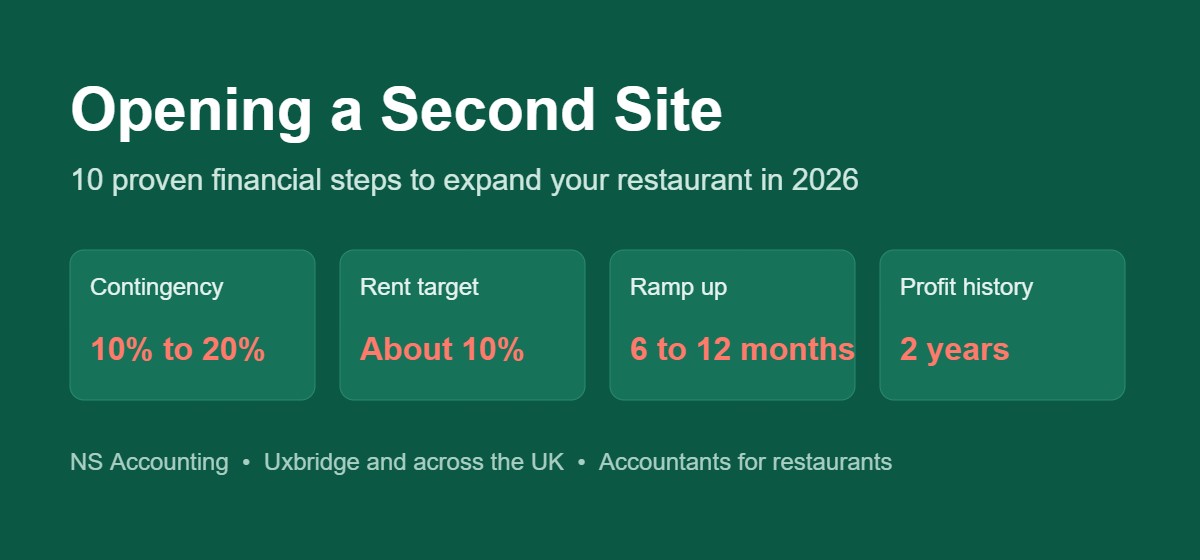
This guide explains how to tell if you are ready, how much opening a second restaurant really costs, how to fund it, the best company structure, the tax and VAT points to plan, and 10 proven financial steps to expand profitably in 2026. If you are thinking about expansion, contact NS Accounting for a free, no obligation consultation.
Are You Ready for Opening a Second Restaurant?
Before opening a second restaurant, be honest about whether your first site is truly ready to run without you. Signs that you are ready include:
- Your first restaurant has been consistently profitable for at least two years
- You have a reliable manager and head chef who can run the site day to day
- Recipes, processes and training are written down, not just in your head
- You produce monthly management accounts and understand your key numbers
- You have cash reserves, or access to funding, beyond the cost of the new site
- Your systems for bookkeeping, payroll and stock can handle more than one location
If several of these are missing, it is usually better to strengthen the first restaurant before opening a second restaurant. The strongest expansions are built on a business that already works well without the owner behind the pass every night.
How Much Does Opening a Second Restaurant Cost?
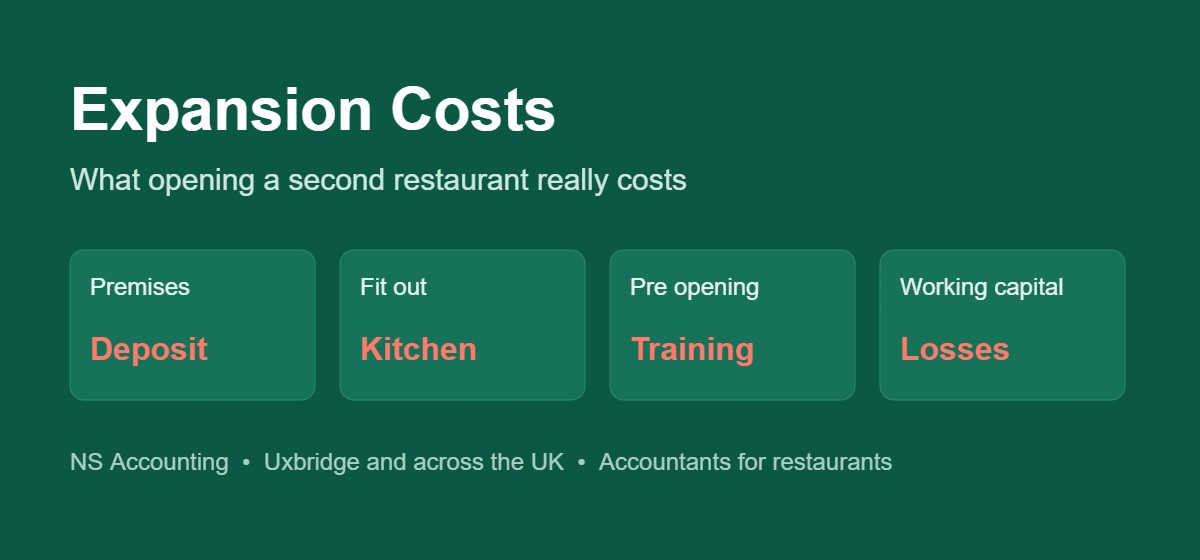
The cost of opening a second restaurant varies widely depending on the size, location, condition of the premises and the type of food you serve. Taking over an existing restaurant with a working kitchen can be far cheaper than fitting out an empty unit. The main costs usually include:
| Cost area | What it includes |
|---|---|
| Premises | Rent deposit, legal fees, lease premium, rent free period |
| Fit out | Kitchen, extraction, plumbing, electrics, furniture, decoration |
| Equipment | Ovens, fridges, dishwashers, EPOS, smallwares |
| Pre opening costs | Recruitment, training wages, marketing, opening stock, licences |
| Working capital | Cash to cover losses during the first months of trading |
| Contingency | Usually 10% to 20% for overruns and surprises |
Working capital is often underestimated. A new site can take six to twelve months to reach its target sales, and during that time it may make a loss. Your plan for opening a second restaurant must include enough cash to cover this period without putting your first restaurant at risk.
Building a Financial Forecast for the New Site
A detailed forecast is the foundation of opening a second restaurant successfully. It should include:
- Weekly sales forecasts based on covers, average spend and seasonality
- Food and drink cost percentages based on your menu
- A full staffing plan with rotas and wage costs
- Rent, business rates, utilities and all other overheads
- A break even analysis showing the sales needed each week
- A cash flow forecast for both sites together
Test the forecast against a pessimistic scenario, such as sales 20% lower than expected. If the group cannot survive that scenario, the plan needs more funding or a lower cost base. Our CFO services include building and stress testing expansion forecasts, and our guide to restaurant cash flow explains how to forecast cash week by week.
Funding Options for Opening a Second Restaurant
Most owners use a combination of funding sources when opening a second restaurant:
- Retained profits from the first restaurant
- Bank loans, which usually require a business plan, forecasts and personal guarantees
- Asset finance for kitchen equipment and EPOS
- Landlord contributions, such as rent free periods or fit out contributions
- Investors or partners, who provide capital in exchange for shares
- Director loans, where you lend personal funds to the company
Lenders and investors will want to see clean accounts for your first restaurant and a credible plan for the second. Accurate statutory accounts and up to date restaurant management accounts make funding applications much stronger.
Choosing the Right Structure
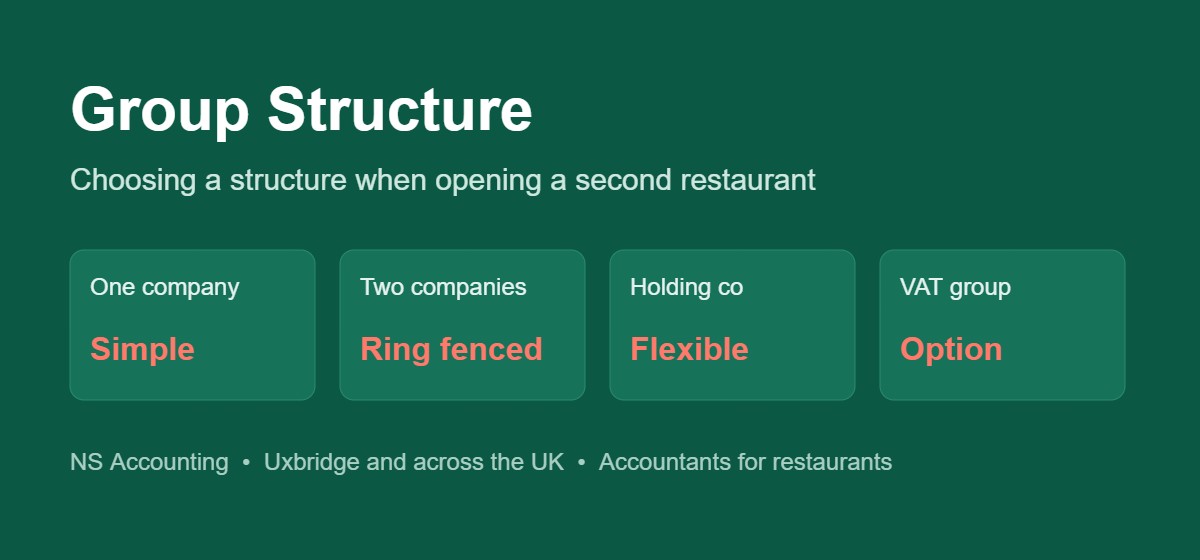
How you structure the business when opening a second restaurant affects risk, tax and future flexibility.
One Company, Two Sites
Running both restaurants through one company is the simplest option. It keeps administration low and allows losses at the new site to be offset against profits at the first. However, if the second site fails, its debts could affect the first restaurant.
Separate Companies for Each Site
Using a new company for the second restaurant ring fences the risk. If the new site struggles, the first restaurant is better protected. The downside is more administration and the need for careful planning so that losses and profits can still be used efficiently.
A Holding Company Group
Many growing restaurant businesses use a holding company that owns separate trading companies for each site. This structure can protect each restaurant, allow group relief for losses and make it easier to sell or bring in investors for individual sites in the future. Our company formation team can set up the right structure.
Tax Points to Plan When Opening a Second Restaurant
Associated Companies and Corporation Tax
If you have more than one company under common control, the £50,000 and £250,000 corporation tax limits are shared between them. This can push more profit into the higher rate, so the structure should be modelled before it is set up.
Capital Allowances
Fit out and equipment for a new restaurant can qualify for capital allowances, often giving 100% tax relief through the Annual Investment Allowance or full expensing. The Annual Investment Allowance is shared between companies in the same group, so purchases need to be planned across the group. Read our guide to capital allowances for restaurants.
VAT Registration and VAT Groups
A new company will need its own VAT registration once its turnover passes the threshold, or it may join a VAT group with your existing company, which allows one VAT return for the group and removes VAT on transactions between group members. Our VAT services can advise on the best option.
Losses in the First Year
A new site often makes a loss at first. With the right structure, these losses can be set against profits elsewhere in the group, reducing the overall tax bill. Our specialist tax advice team can plan this in advance.
10 Proven Financial Steps for Opening a Second Restaurant
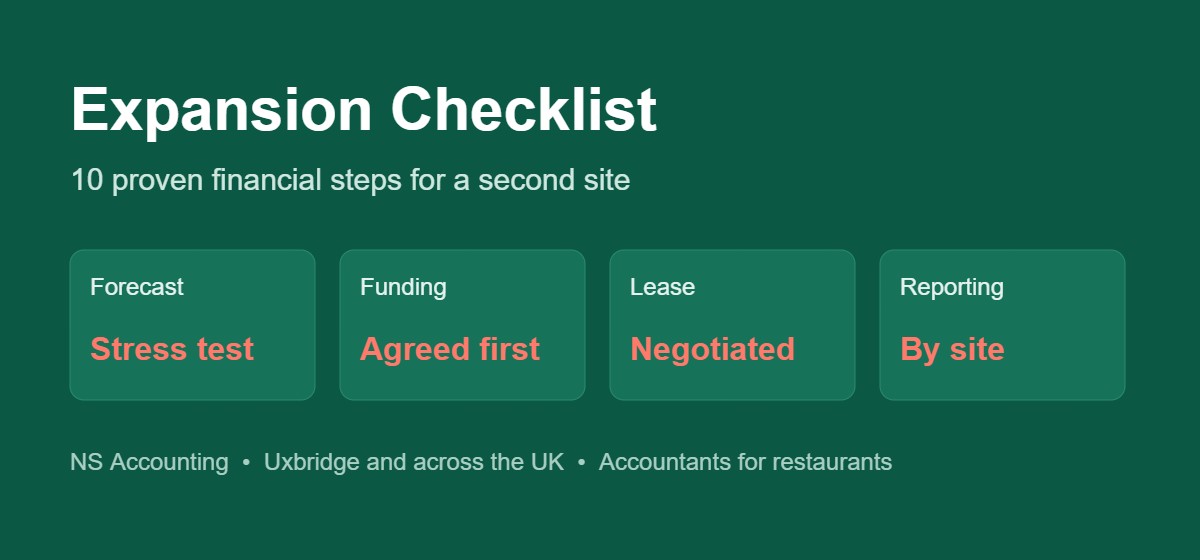
These are the steps we follow with clients who are opening a second restaurant.
1. Strengthen Your First Restaurant First
Make sure the first site is profitable, well managed and running smoothly without you.
2. Get Monthly Management Accounts in Place
You need clear monthly numbers for the first site before you can plan the second.
3. Build a Detailed Forecast
Forecast sales, costs, cash and break even for the new site, and test a pessimistic scenario.
4. Budget Generously for Fit Out
Get quotes, add a contingency of 10% to 20% and plan purchases to make the most of tax relief.
5. Secure Funding Before You Commit
Have funding agreed before you sign the lease, so you are not forced into expensive finance later.
6. Choose the Right Structure
Decide between one company, separate companies or a holding company group before trading begins.
7. Negotiate the Lease Carefully
Seek rent free periods, break clauses and landlord contributions. A good lease can make the difference between profit and loss.
8. Set Up Site Level Reporting
Track sales, food cost, wage cost and profit by site from day one, so you can compare performance.
9. Centralise Systems and Purchasing
Use the same EPOS, accounting software, payroll and suppliers across both sites to save time and negotiate better prices.
10. Review Performance Monthly and Act Quickly
Compare actual results with your forecast each month and act quickly if the new site falls behind. Small problems are far easier to fix in the first few months than after a year of losses.
Key Numbers to Track Across Both Sites
Once both restaurants are trading, compare each site every month using the same measures. The most useful are sales against forecast, food and drink cost percentage, wage cost percentage, average spend per cover, covers per week, gross profit, site profit after direct costs and cash generated. Looking at these side by side quickly shows whether the new site is on track and where to focus your attention. It also highlights good practice at one site that can be copied at the other.
Managing Payroll and People Across Two Sites
Staffing a second restaurant is often the hardest part of expansion. You need a manager and head chef you can trust, and enough experienced staff to keep standards high at both sites. Moving your best people from the first restaurant can weaken it, so plan recruitment and training well before opening.
Payroll becomes more complex with two sites, especially if staff work across both locations or if you use separate companies. Tronc schemes, holiday pay and auto enrolment must all be handled correctly. Our payroll management service manages multi site payroll with reporting by location, and our guide to restaurant payroll covers the rules.
Choosing the Right Location
Location is one of the biggest factors in the success of opening a second restaurant. A site close to your first restaurant makes management easier and allows staff, stock and equipment to be shared, but it may also take customers away from your existing site. A site further away may reach new customers, but it will be harder to supervise and will rely more on local management.
Look carefully at footfall, parking, public transport, nearby offices and homes, local competition and the evening and weekend trade. Visit the area at different times of day and on different days of the week. Compare the rent with realistic sales, as a common rule of thumb is that rent should be no more than around 10% of expected sales. When opening a second restaurant, a cheaper site in a weaker location is rarely a bargain.
Central Kitchens and Shared Costs
Once you have two or more sites, it may make sense to prepare some dishes, sauces or baked goods centrally. A central kitchen can improve consistency, reduce waste and lower labour costs at each site. However, it adds its own costs, such as rent, equipment, staff and delivery between sites.
Shared costs, including head office staff, marketing, accountancy and your own time, should be allocated fairly between sites in your management accounts. This gives a true picture of each restaurant’s profit and helps you make better decisions about pricing, staffing and future expansion.
Business Rates, Licences and Compliance for the New Site
Every new restaurant needs its own business rates account, food business registration with the local council at least 28 days before opening, and, if you sell alcohol, a premises licence. If you open late, you may also need a late night refreshment licence. Check whether the new site qualifies for any business rates relief, as the reliefs available for a second property can differ from those for a single site business. Build these costs and timescales into your plan when opening a second restaurant, as delays in licensing can push back your opening date and increase pre opening costs.
Alternatives to Opening a Second Restaurant
Opening a second restaurant is not the only way to grow. Some owners increase profit by improving the first site, adding a delivery only brand from the same kitchen, launching catering or events, selling products such as sauces or meal kits, or extending opening hours. Others consider franchising or licensing their brand, which can allow faster growth with less capital, although it brings legal costs and less direct control. Comparing these options with your expansion plan helps you choose the route with the best return for the risk involved.
An Example of Opening a Second Restaurant
Consider a successful restaurant in Uxbridge with annual sales of £650,000 and profit of £90,000. The owner found a site in a nearby town and planned to open within three months, funding the fit out from the first restaurant’s bank account.
We built a forecast that showed the new site would need around £180,000 including working capital and contingency, rather than the £110,000 the owner had expected. We set up a holding company with a separate trading company for the new site, arranged a bank loan and asset finance for equipment, and negotiated a six month rent free period. The second restaurant opened two months later than planned, but with enough funding to trade through a slow start, and both sites were profitable within the first year. Figures are illustrative, but this shows how planning protects owners when opening a second restaurant.
Common Mistakes When Opening a Second Restaurant
- Expanding before the first restaurant can run without the owner
- Underestimating fit out and working capital needs
- Funding the new site from the first restaurant’s day to day cash
- Choosing a structure without modelling the tax
- Signing a lease before funding is agreed
- Not tracking performance separately by site
- Taking the best staff away from the first restaurant
Why Choose NS Accounting for Opening a Second Restaurant?
NS Accounting is a firm of accountants based in Uxbridge, supporting restaurants, cafes and takeaways across Hillingdon, Ruislip, Hayes, West Drayton, Southall, Ealing, Slough and the rest of the UK. When you are opening a second restaurant, we help with:
- Expansion forecasts, break even analysis and funding applications
- Company structure, holding companies and group planning
- Capital allowances, VAT and corporation tax planning
- Multi site bookkeeping, payroll and management accounts
- Self Assessment and director pay planning
- Ongoing CFO support as your group grows
Learn more about our accountants for restaurants service, read our client testimonials or meet the team. For information on government backed finance, see the British Business Bank.
Plan Opening a Second Restaurant With Confidence Today
Growth should make your business stronger, not put it at risk. Whether you are planning a second cafe in Uxbridge, a new takeaway in West London or a group of restaurants across the UK, NS Accounting can help you plan every financial step.
Book your free, no obligation expansion review with NS Accounting today. Call us, message us on WhatsApp or get a free quote online, and let us help make opening a second restaurant the success it deserves to be.
