

Many restaurants that close are not unprofitable on paper. They simply run out of cash. A quiet January, a large VAT bill, a broken fridge and a rent increase can arrive in the same month, and even a busy restaurant can find itself unable to pay suppliers or staff.
That is why managing restaurant cash flow is one of the most important skills any owner can develop. At NS Accounting, we help restaurants, cafes and takeaways in Uxbridge, Hillingdon, West London and across the UK forecast, control and improve restaurant cash flow, so owners can plan with confidence instead of worrying about the bank balance.
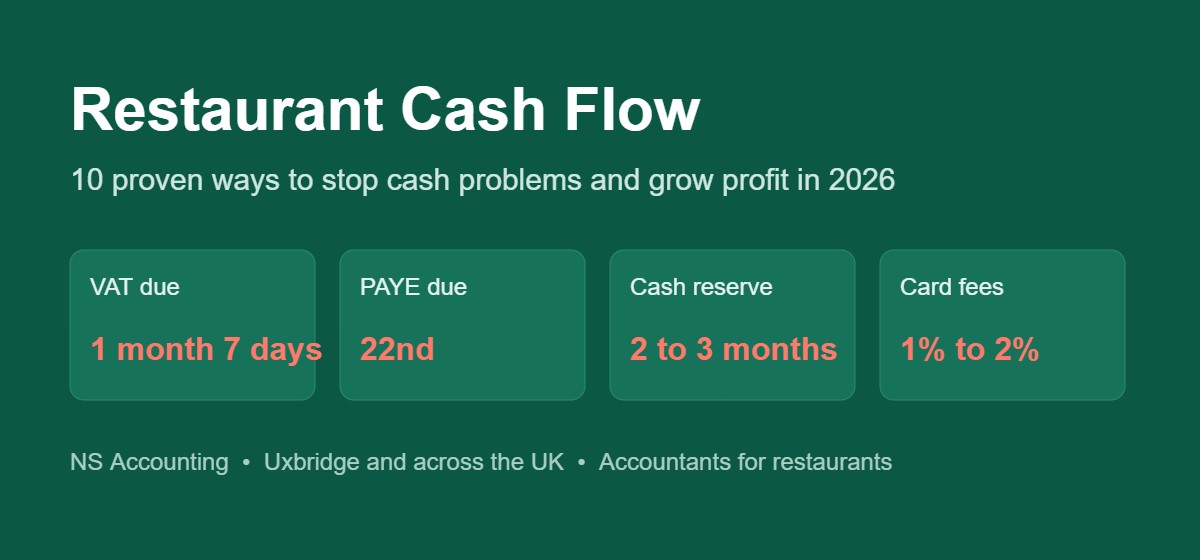
This guide explains what restaurant cash flow is, why profit and cash are not the same, how to build a simple cash flow forecast, and 10 proven ways to improve restaurant cash flow in 2026. If your cash feels tight right now, contact NS Accounting for a free, no obligation consultation.
What Is Restaurant Cash Flow?
Restaurant cash flow is the movement of money into and out of your business over a period of time. Cash flows in from customer payments, delivery platform payouts, event deposits and gift card sales. Cash flows out to suppliers, staff, landlords, HMRC, utility companies, lenders and equipment providers.
Positive restaurant cash flow means more money comes in than goes out over a period. Negative restaurant cash flow means you are spending more than you receive, which can only continue while you have savings or borrowing to fall back on. The aim is not just to make a profit, but to make sure cash is available when bills fall due.
Why Profit and Cash Are Not the Same
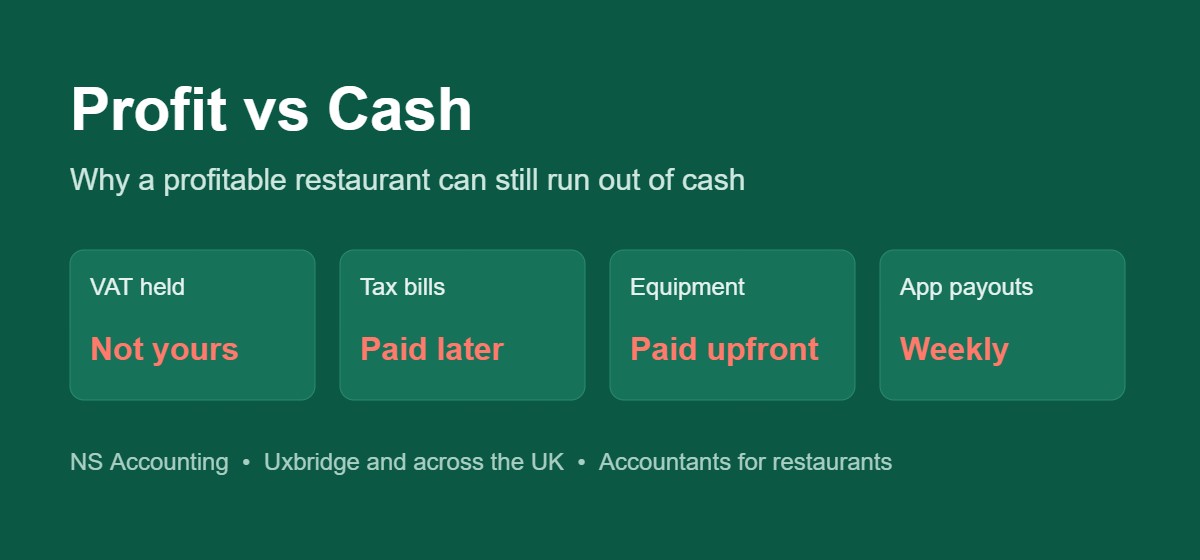
Your profit and loss account might show a healthy profit, while your bank account tells a very different story. This happens for several reasons:
- VAT collected from customers sits in your account until the quarterly VAT payment is due
- Corporation tax and Self Assessment bills are paid months after the profit is earned
- Equipment and refurbishment are paid for upfront but spread over several years in your accounts
- Loan repayments reduce your cash but are not an expense in your profit and loss account
- Stock bought in advance ties up cash before it is sold
- Delivery platforms usually pay weekly, so there is a delay between the sale and the cash
Understanding these differences is the first step to better restaurant cash flow. A restaurant that treats the VAT in its bank account as spare cash will almost always struggle when the VAT bill arrives.
The Restaurant Cash Flow Cycle
Restaurants have a short cash cycle compared with many businesses. Customers usually pay immediately, while suppliers often give 7 to 30 days of credit. In theory, this should create healthy restaurant cash flow. In practice, large fixed costs such as rent, wages and business rates, combined with seasonal sales and big quarterly tax payments, create sharp peaks and troughs.
The table below shows typical timing for the main cash flows in a UK restaurant.
| Cash flow | Typical timing |
|---|---|
| Card and cash sales | Same day or next working day |
| Delivery platform payouts | Usually weekly |
| Food and drink suppliers | 7 to 30 days |
| Wages | Weekly, fortnightly or monthly |
| PAYE and National Insurance | 22nd of the following month |
| Rent | Monthly or quarterly in advance |
| VAT | One month and seven days after each quarter |
| Corporation tax | Nine months and one day after the year end |
How to Build a Restaurant Cash Flow Forecast
A restaurant cash flow forecast shows the cash you expect to receive and pay out over the coming weeks and months. It is the single most useful tool for avoiding cash surprises. A simple forecast can be built in a spreadsheet or in cloud accounting software such as Xero or QuickBooks.
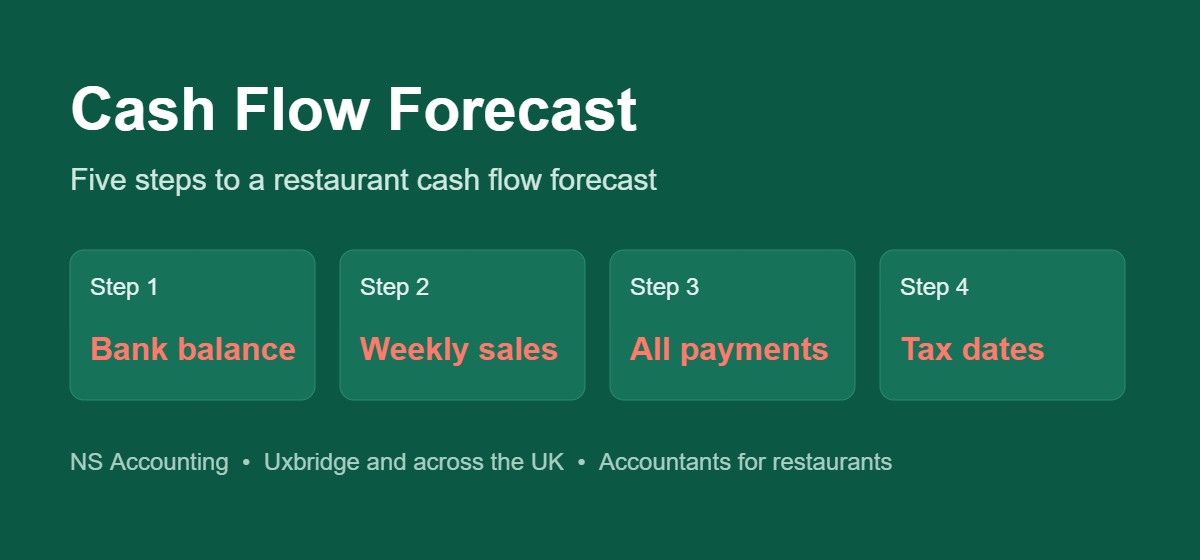
Step 1: Start With Your Opening Bank Balance
Begin with the actual cash in your bank accounts today, including any savings accounts used for tax.
Step 2: Forecast Sales by Week
Use last year’s sales, current bookings and known events to estimate weekly sales. Remember seasonal patterns, school holidays, Christmas, Valentine’s Day, Mother’s Day and quiet periods such as January.
Step 3: Add Every Cash Payment
Include food and drink purchases, wages, PAYE, pensions, rent, business rates, utilities, insurance, card fees, loan repayments, equipment finance, marketing, repairs and professional fees.
Step 4: Add Tax Payments on the Right Dates
Put VAT, corporation tax, Self Assessment and payments on account into the forecast on the dates they will actually be paid.
Step 5: Review and Update Every Week
A restaurant cash flow forecast is only useful if it is kept up to date. Compare actual cash with your forecast each week and adjust future weeks as your plans change.
Our CFO services include building and maintaining rolling 13 week and 12 month restaurant cash flow forecasts for our clients.
Warning Signs of Restaurant Cash Flow Problems
Watch out for these early warning signs:
- Using your overdraft every month rather than only occasionally
- Delaying supplier payments or being put on stop
- Struggling to pay VAT or PAYE on time
- Using personal savings or credit cards to pay business bills
- Not knowing how much tax you will owe in the coming months
- Falling gross profit margins without a clear reason
If you recognise any of these signs, act quickly. Restaurant cash flow problems are much easier to solve early than when bills are already overdue.
10 Proven Ways to Improve Restaurant Cash Flow
These are the strategies our team uses most often to strengthen restaurant cash flow.
1. Set Aside VAT and Tax Every Week
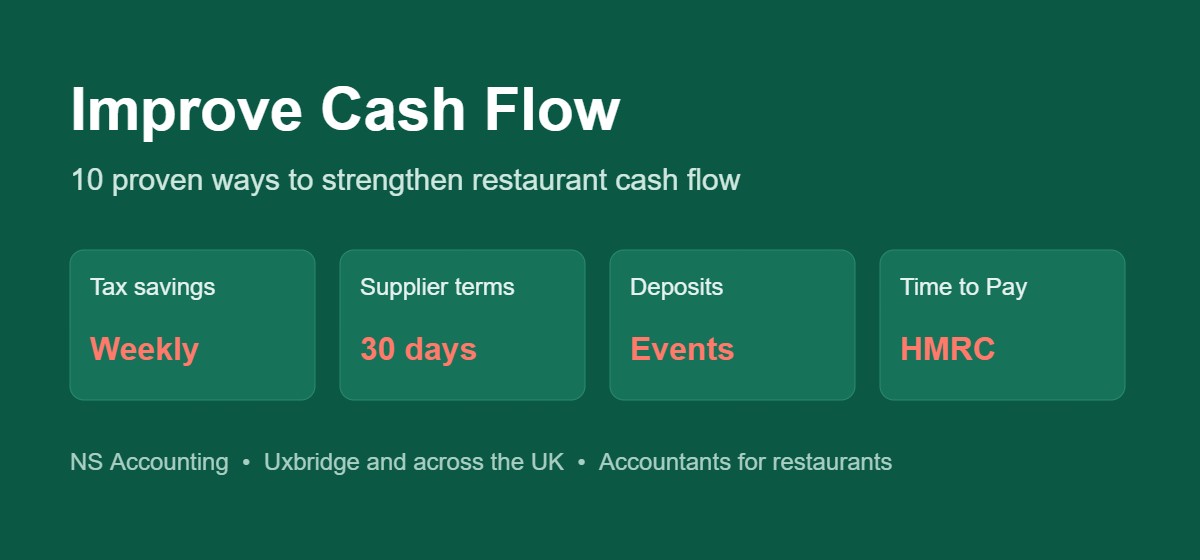
Open a separate savings account and transfer a percentage of weekly sales to cover VAT, PAYE and corporation tax. This simple habit prevents most restaurant cash flow crises. Our VAT services can calculate the right amount to set aside.
2. Control Stock Levels
Excess stock is cash sitting on shelves. Order little and often, rotate stock carefully and avoid bulk buying unless the saving is significant and you have the cash to support it.
3. Negotiate Better Supplier Terms
Ask suppliers for longer payment terms, especially once you have a good payment record. Moving from 7 day to 30 day terms on a large food bill can improve restaurant cash flow significantly.
4. Reduce Food Waste
Every item thrown away is cash lost. Track waste daily, adjust prep levels and use menu planning to make the most of every ingredient.
5. Match Rotas to Forecast Sales
Wages are usually your largest cost after food. Planning rotas around expected covers protects restaurant cash flow during quiet periods. Our payroll management service and guide to restaurant payroll explain how to manage staff costs.
6. Take Deposits for Large Bookings and Events
Ask for deposits on group bookings, private dining, Christmas parties and outside catering. Deposits bring cash in early and reduce the cost of no shows.
7. Review Delivery Platform Profitability
Delivery apps pay weekly and charge high commission. Make sure your app prices cover commission and that you know the true profit of each platform. Our guide to delivery platform accounting explains how.
8. Spread the Cost of Equipment
Leasing or financing large equipment can protect restaurant cash flow, while still allowing you to claim tax relief. Compare the total cost of finance carefully. Our guide to capital allowances for restaurants explains the tax relief available.
9. Use a Time to Pay Arrangement if Needed
If you cannot pay a tax bill in full, contact HMRC before the deadline. HMRC may agree a Time to Pay arrangement, allowing you to pay in instalments. Acting early avoids extra penalties and shows good faith.
10. Review Management Accounts Monthly
Monthly management accounts show your sales, margins and costs while there is still time to act. Combined with a cash flow forecast, they give you a complete picture. Read our guide to restaurant management accounts to learn more.
Seasonal Restaurant Cash Flow Planning
Most restaurants have predictable busy and quiet periods. December is often the busiest month, followed by a sharp drop in January, when customers cut back and VAT on December sales falls due soon after. Summer can be busy for restaurants with outdoor seating and quiet for those near offices.
Good seasonal planning means building a cash reserve during busy months to cover quieter ones. A restaurant cash flow forecast that covers at least 12 months makes these patterns visible. Many owners aim to keep a reserve of at least two to three months of fixed costs, including rent, wages and loan repayments.
Funding Options for Restaurant Cash Flow
Sometimes even well managed restaurants need extra funding, for example to open a new site, carry out a refurbishment or cover an unexpected problem. Common options include:
- Business overdrafts for short term fluctuations
- Business loans for planned investment
- Asset finance and leasing for kitchen equipment
- Merchant cash advances, repaid as a percentage of card sales, which can be expensive
- Director loans, where you lend money to your own company
Each option has a different cost and risk. Before borrowing, use your restaurant cash flow forecast to check that the repayments are affordable even in quieter months.
Card Fees and Payment Timing
Most customers now pay by card or phone, which is convenient but not free. Card processing fees typically cost between 1% and 2% of card sales, and some providers add monthly terminal charges, minimum fees or extra charges for business and international cards. On annual card sales of £500,000, the difference between a rate of 1.2% and 1.8% is £3,000 a year.
Payment timing matters too. Some providers settle funds the next working day, while others hold money for longer or settle weekly. Faster settlement means cash reaches your account sooner. It is worth reviewing your provider every year and asking for better terms as your sales grow.
Rent, Business Rates and Lease Negotiations
Rent is usually your largest fixed cost after wages. Many leases require rent to be paid quarterly in advance, which creates a large outflow four times a year. Asking your landlord to accept monthly payments spreads the cost and smooths your cash.
When a lease is renewed or a rent review is due, take professional advice and use your sales and profit figures to support your negotiating position.
From April 2026, many hospitality properties benefit from permanently lower business rates multipliers, and smaller properties may also qualify for Small Business Rate Relief. Check that your rateable value is correct and that you receive every relief available. Many councils also allow business rates to be paid over 12 monthly instalments rather than 10, which helps cash flow.
Cutting Overheads Without Hurting Service
Overheads such as energy, insurance, waste collection, software subscriptions and maintenance contracts tend to creep up over time. A yearly review of every regular payment often finds savings. Energy is a particular concern for restaurants with large kitchens, so compare tariffs, check that your contract matches your usage and consider simple efficiency measures such as switching off equipment during quiet periods and maintaining fridges and extraction properly.
Look carefully at subscriptions too. Many restaurants pay for booking systems, rota apps, loyalty platforms and marketing tools that overlap or are no longer used. Cancelling unused services frees up cash without any effect on your customers.
Managing Supplier Relationships
Strong relationships with suppliers are valuable. Paying on time builds trust and makes it easier to ask for better prices, longer terms or flexibility during a difficult month. Compare prices regularly, but avoid switching suppliers constantly for small savings, as reliability and quality matter in a busy kitchen. Check every delivery against the invoice, record credits for missing or damaged items and make sure you are not paying for goods you did not receive.
A Restaurant Cash Flow Example
Consider a restaurant in Uxbridge with annual sales of £600,000 and a healthy profit on paper. Each quarter, the owner struggled to pay VAT of around £25,000 and regularly used a costly overdraft.
There was no cash flow forecast, and VAT collected from customers was spent as part of everyday cash.
We introduced a weekly transfer of 15% of sales into a tax savings account, negotiated 30 day terms with the two largest food suppliers and built a rolling 13 week restaurant cash flow forecast. Within six months, the restaurant no longer used its overdraft, VAT was paid on time every quarter, and the owner had built a reserve to cover January. Figures are illustrative, but this kind of improvement is very common when restaurant cash flow is managed properly.
The owner also gained something harder to measure. With a clear forecast in place, decisions about hiring, menu changes and equipment purchases could be made calmly, based on real numbers rather than guesswork. Knowing what the bank balance would look like in three months removed a great deal of stress and allowed the owner to focus on running a great restaurant.
Restaurant Cash Flow for New and Growing Restaurants
New restaurants face particular cash flow pressure. Fit out costs, deposits, opening stock and pre opening wages are paid before the first customer walks through the door. Our restaurant startup accounting guide explains how to plan opening costs and working capital.
Growing restaurants opening a second site need to be equally careful. A new site can take several months to become profitable, and the first site often has to support it. A detailed restaurant cash flow forecast for the group shows how much funding is needed and when.

How NS Accounting Helps With Restaurant Cash Flow
NS Accounting is a firm of accountants based in Uxbridge, supporting restaurants, cafes and takeaways across Hillingdon, Ruislip, Hayes, West Drayton, Southall, Ealing, Slough and the rest of the UK. Our restaurant cash flow support includes:
- Rolling 13 week and 12 month cash flow forecasts
- Monthly bookkeeping and management accounts
- Tax planning so you know what to set aside and when
- Support with HMRC Time to Pay arrangements
- Funding and investment appraisals
- Statutory accounts, Self Assessment and specialist tax advice
Learn more about our accountants for restaurants service, read our client testimonials or meet the team. If you are struggling to pay a tax bill, HMRC explains the options on its difficulties paying HMRC page.
Take Control of Your Restaurant Cash Flow Today
Cash is the lifeblood of every restaurant. Whether you run a single cafe in Uxbridge, a takeaway in West London or a group of restaurants across the UK, NS Accounting can help you forecast, control and improve your cash.
Book your free, no obligation restaurant cash flow review with NS Accounting today. Call us, message us on WhatsApp or get a free quote online, and let us help you build stronger restaurant cash flow and a more secure future for your business.
