

Running a takeaway is fast, demanding and full of financial traps. Hot food VAT, delivery app commission, cash sales, driver costs and late night staffing all affect your profit, and HMRC pays close attention to the sector. That is why choosing specialist takeaway accountants can make such a difference. At NS Accounting, we are takeaway accountants for pizza shops, kebab shops, fish and chip shops, curry houses, Chinese takeaways, burger bars, chicken shops and dark kitchens in Uxbridge, Hillingdon, West London and across the UK.
This guide explains what takeaway accountants do, the key numbers every takeaway owner should track, the biggest tax and VAT risks, and 10 proven ways takeaway accountants help you grow profit in 2026. If you want help straight away, contact NS Accounting for a free, no obligation consultation.
What Do Takeaway Accountants Do?
Takeaway accountants manage the financial side of your takeaway so you can concentrate on cooking, serving and growing. Unlike general accountants, specialist takeaway accountants understand how takeaways actually trade, from hot food VAT and delivery platforms to cash handling, driver costs and late night wages.
Our takeaway accountants provide:
- Bookkeeping, bank reconciliations and EPOS and delivery app integration
- VAT registration and quarterly VAT returns
- Payroll for kitchen staff, counter staff and delivery drivers
- Year end accounts, corporation tax returns and Self Assessment
- Monthly management accounts and cash flow forecasts
- Tax planning, business structure and director pay advice
- Support with HMRC enquiries and VAT inspections
Why Takeaways Need Specialist Takeaway Accountants
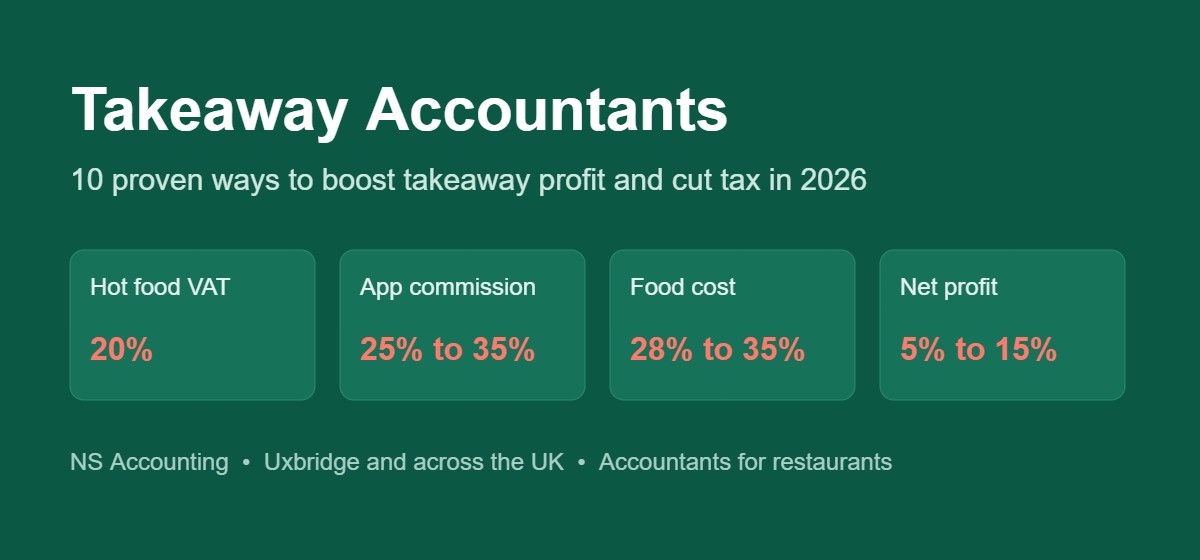
Most takeaway food is hot, which means most of your sales are standard rated for VAT at 20%. At the same time, many of your ingredients are zero rated, so you reclaim very little input VAT. Delivery apps take a large share of each order, and food, packaging and energy costs have risen sharply. Profit margins in many takeaways are now between 5% and 15% of sales, so every pound counts.
Takeaways also face more HMRC scrutiny than many other businesses. Cash sales, high staff turnover and the complexity of the hot food rules mean HMRC regularly checks takeaways for VAT, minimum wage and income tax compliance. Specialist takeaway accountants keep your records clean and your returns consistent, so you are in a strong position if HMRC ever asks questions.
Key Numbers Every Takeaway Owner Should Track
Good takeaway accountants focus on a small number of figures that show how healthy your business is. The table below gives typical UK benchmarks.
| Measure | Typical UK takeaway benchmark |
|---|---|
| Food and packaging cost | 28% to 35% of sales |
| Staff costs, including drivers | 20% to 30% of sales |
| Delivery app commission | 25% to 35% of app sales |
| Rent, rates and utilities | 8% to 15% of sales |
| Net profit | 5% to 15% of sales |
Your own figures will depend on your menu, location and how much you sell through apps. The important thing is to measure them every month, compare them with these benchmarks and act quickly when costs drift.
Hot Food VAT: The Biggest Issue for Takeaways
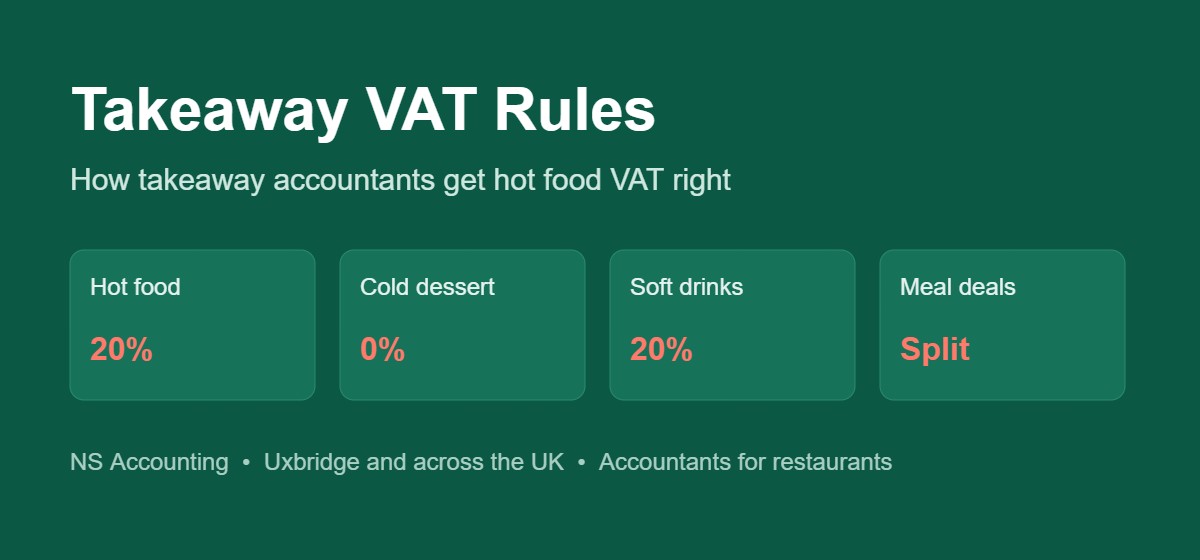
Hot takeaway food is standard rated at 20%. Food counts as hot if it is heated so it can be eaten hot, kept hot after cooking, or advertised and supplied as hot. Pizzas, kebabs, curries, fried chicken, burgers and fish and chips are all standard rated when sold hot. However, some items on a takeaway menu can be zero rated when sold cold, such as cold desserts, cold sandwiches and some milkshakes, while soft drinks, crisps and confectionery are standard rated.
Takeaway accountants make sure your EPOS has the right VAT code for every menu item, including meal deals that combine standard rated and zero rated items. Meal deals need a fair split of the price between their parts, and getting this wrong can lead to large VAT assessments. Our VAT services include a full menu review, and our detailed guide to VAT for restaurants explains the hot and cold food rules in depth.
Delivery Apps: Counting the True Cost
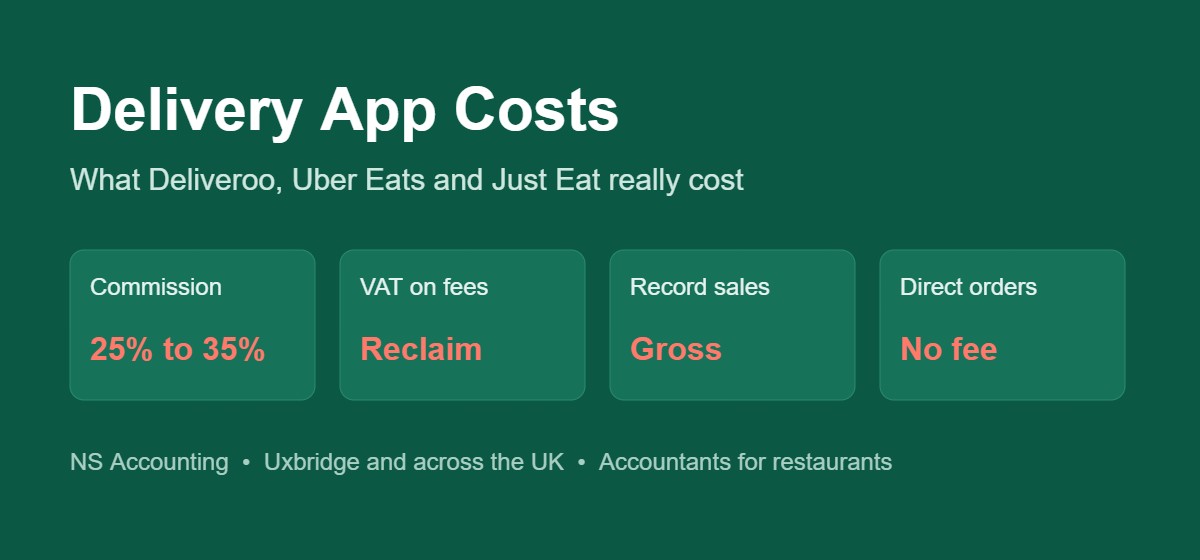
Deliveroo, Uber Eats and Just Eat can bring a steady stream of orders, but commission rates of 25% to 35% can wipe out the profit on many orders. Takeaway accountants help you understand exactly what each platform earns you after commission, promotions, refunds and packaging.
It is also vital to record app sales correctly. You usually need to account for VAT on the full price the customer paid, not the net payout you receive. The platform’s commission normally includes VAT, which you can reclaim with a valid invoice. Recording only the net payout understates your sales and overstates your profit margin, which can attract HMRC attention. Read our guide to delivery platform accounting for a step by step explanation.
Cash Sales and HMRC Compliance
Although card payments now dominate, many takeaways still take cash, especially late at night. HMRC uses data from card providers, delivery apps, banks and suppliers to estimate what a business should be earning. If your declared sales look low compared with your purchases, HMRC may open an enquiry.
Electronic sales suppression tools, which hide or delete sales from EPOS systems, are illegal to make, supply or possess, and carry significant penalties. Takeaway accountants help you set up clear cash procedures, cash up every shift, bank takings regularly and keep full records. Clean records are the best defence if HMRC opens an investigation, and our specialist tax advice team can represent you if that happens.
Delivery Drivers: Employed or Self Employed?
Many takeaways use their own delivery drivers. Whether a driver is an employee or genuinely self employed depends on how they work in practice, not just what the contract says. Drivers who work set shifts, wear your uniform, deliver only for you and are told how to do the job are usually employees, which means they must go through payroll and receive minimum wage, holiday pay and pension rights.
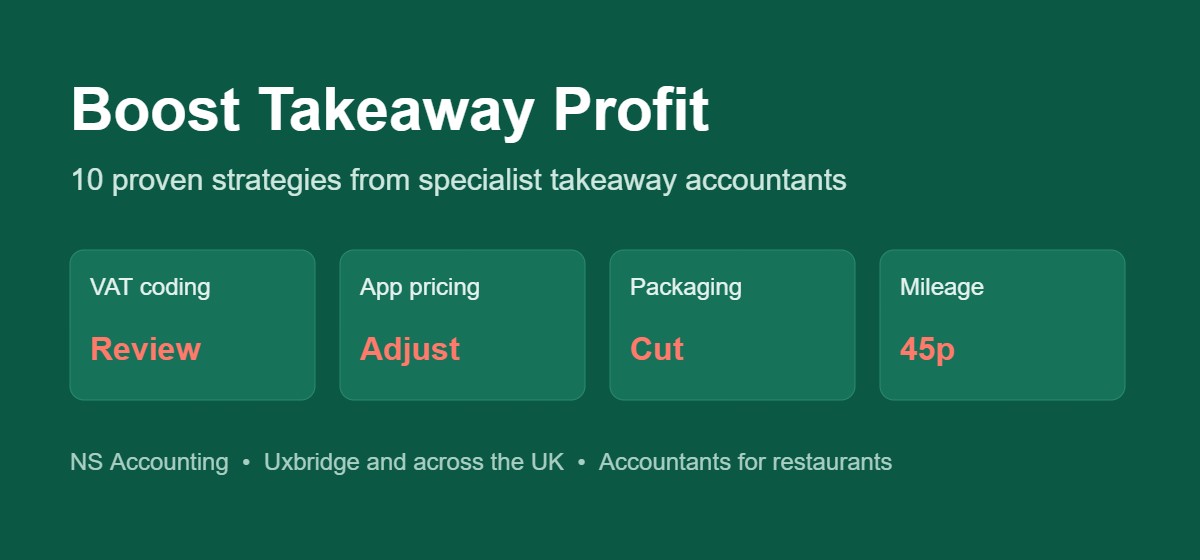
If drivers use their own vehicles, you can usually pay up to 45p per mile for the first 10,000 business miles in a tax year without tax or National Insurance. Takeaway accountants can review your driver arrangements and help you avoid costly employment status disputes.
10 Proven Ways Takeaway Accountants Boost Profit
These are the strategies our takeaway accountants use most often with takeaway clients.
1. Review VAT Coding on Every Menu Item
Correct VAT coding, especially on meal deals, cold items and drinks, can save thousands of pounds a year and protect you from assessments.
2. Price Delivery App Menus Separately
Many takeaways charge higher prices on delivery apps to cover commission. Takeaway accountants calculate the price increase you need to keep the same profit per order.
3. Encourage Direct Orders
Orders through your own website, app or phone line avoid platform commission. Even moving 10% of app orders to direct ordering can add thousands to your annual profit.
4. Control Food Costs and Portion Sizes
Standard recipes and portion controls keep your food cost percentage on target. Takeaway accountants track food cost every month so you can see the effect of supplier price rises.
5. Cut Packaging Waste
Packaging is a growing cost. Reviewing suppliers and choosing the right sizes for each dish can reduce packaging spend without hurting quality.
6. Plan Staffing Around Peak Hours
Takeaways often have very busy evening peaks. Matching rotas to demand keeps wage costs under control. Our payroll management service handles weekly pay runs, pensions and minimum wage checks.
7. Claim Capital Allowances on Equipment
Fryers, pizza ovens, grills, extraction, fridges and EPOS systems can qualify for capital allowances, often giving 100% tax relief in the year of purchase. See our guide to capital allowances for restaurants and takeaways.
8. Choose the Right Business Structure
Many takeaways start as sole traders or partnerships. Once profits grow, a limited company can reduce tax and protect your personal assets. Our company formation service can help when the time is right.
9. Pay Yourself Tax Efficiently
A tax efficient mix of salary, dividends and pension contributions can significantly reduce your personal tax bill. Takeaway accountants review this every year as tax rates change.
10. Review Monthly Management Accounts
Monthly figures show your sales, food cost, wage cost and profit while there is still time to act. Our guide to restaurant management accounts explains what to look for.
Dark Kitchens and Delivery Only Brands
Dark kitchens, also known as ghost kitchens or virtual brands, sell only through delivery apps and have no customer seating. They avoid some costs, such as front of house staff and prime high street rent, but depend completely on platform commission and online marketing. Takeaway accountants help dark kitchen operators understand profit by brand, allocate shared kitchen costs fairly and plan cash flow around weekly platform payouts.
If you run several virtual brands from one kitchen, separate reporting by brand shows which menus are worth keeping and which are losing money. This kind of insight is difficult to get without accountants who understand delivery led businesses.
Making Tax Digital for Sole Trader Takeaways
From April 2026, sole traders with qualifying income above £50,000 must keep digital records and send quarterly updates to HMRC under Making Tax Digital for Income Tax, with the threshold falling to £30,000 from April 2027. Many takeaway owners trading as sole traders will be affected, because the test is based on turnover rather than profit. Our MTD Income Tax accountants can set up compatible software and file every quarterly update for you.
Opening a New Takeaway
If you are planning to open a takeaway, the decisions you make before you open will shape your profit for years. You will need a realistic business plan, a cash flow forecast that covers fit out and the first few months of trading, and a clear view of how many orders you need each week to break even. You should also decide whether to trade as a sole trader or limited company, when to register for VAT, and how you will record sales from your counter, phone, website and delivery apps.
Fit out costs for a takeaway kitchen can be high, especially extraction, ventilation and fire safety work. Planning these purchases carefully allows you to claim the right tax reliefs. Our restaurant and takeaway startup accounting guide covers every step in detail.
Franchise Takeaways
Many takeaway owners operate under a franchise brand. Franchises bring recognised branding and established systems, but they also bring ongoing royalty and marketing fees, which are usually a percentage of sales. Before buying a franchise, it is important to test the numbers carefully, including the initial fee, fit out costs, ongoing fees and realistic sales. Once trading, franchisees often need to provide regular financial reports to the franchisor, so accurate monthly bookkeeping is essential.
Licences, Hygiene and Other Running Costs
Takeaways have several running costs that are easy to overlook in a budget. If you sell hot food or drink between 11pm and 5am, you will usually need a late night refreshment licence from your local council. Food hygiene training, pest control, waste collection, oil disposal, insurance and equipment servicing all add to your monthly costs. Most of these are allowable business expenses, so keeping receipts and recording them properly reduces your tax bill.
Year End Accounts and Tax Deadlines for Takeaways
Sole trader takeaways report their profit on a Self Assessment tax return, due by 31 January after the end of the tax year. Limited companies must file annual accounts with Companies House within nine months of the year end, pay corporation tax within nine months and one day, and file a company tax return within 12 months. VAT returns are usually due one month and seven days after the end of each VAT quarter, and payroll submissions must be made on or before each payday. A clear deadline calendar avoids automatic penalties and interest.
A Takeaway Accountants Example
Consider a pizza takeaway in Uxbridge with annual sales of £420,000, of which 55% came through delivery apps. The owner traded as a sole trader, recorded only net app payouts in the books and charged VAT at 20% on all items, including cold desserts and some milkshakes.
After a review by our takeaway accountants, the sales records were corrected to show gross app sales, protecting the business from HMRC challenge. VAT coding was corrected on cold items, saving around £3,000 a year. App menu prices were adjusted to cover commission, adding around £12,000 of gross profit, and a move to a limited company reduced the owner’s tax bill by around £7,000. Figures are illustrative, but results like these are common when takeaways work with specialist takeaway accountants.
Common Mistakes Takeaways Make With Their Finances
- Recording only net delivery app payouts instead of gross sales
- Charging 20% VAT on items that could be zero rated
- Not splitting meal deal prices correctly for VAT
- Treating delivery drivers as self employed without checking their status
- Poor cash records that make it hard to defend declared sales
- Missing VAT registration when turnover passes £90,000
- Mixing personal and business spending in the same bank account
Each of these can be fixed quickly with the right systems and regular support from takeaway accountants.
How to Choose the Best Takeaway Accountants
When comparing takeaway accountants, look for experience with takeaways and delivery led businesses, strong knowledge of hot food VAT, practical advice on delivery app profitability, cloud accounting expertise, and fixed monthly fees. Our guide to restaurant and takeaway accountant fees explains typical UK prices.
Why Choose NS Accounting as Your Takeaway Accountants?
NS Accounting is a firm of accountants based in Uxbridge, supporting takeaways, restaurants and cafes across Hillingdon, Ruislip, Hayes, West Drayton, Southall, Ealing, Slough and the rest of the UK. As your takeaway accountants, we offer:
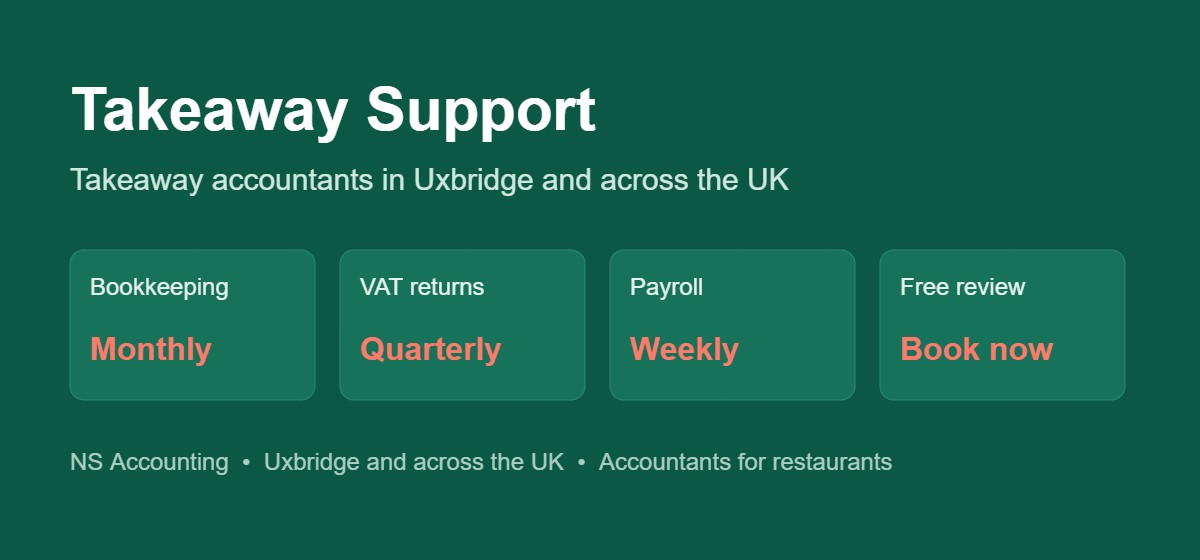
- Monthly bookkeeping with delivery app reconciliation
- VAT returns with correct hot and cold food treatment
- Weekly payroll for kitchen staff and drivers
- Statutory accounts and company tax returns
- Self Assessment for sole traders and directors
- Growth support through our CFO services for multi site and franchise takeaways
Learn more about our accountants for restaurants and takeaways service, read our client testimonials or meet the team. For official guidance on hot food, see HMRC’s catering and takeaway food VAT notice.
Speak to Specialist Takeaway Accountants Today
Every month without clear numbers is profit you may never get back. Whether you run a single takeaway in Uxbridge, a dark kitchen in West London or a group of takeaways across the UK, NS Accounting can review your figures and show you exactly where you could save.
Book your free, no obligation consultation with our takeaway accountants today. Call us, message us on WhatsApp or get a free quote online, and let our takeaway accountants help you pay less tax and keep more profit.
